Physical Address
304 North Cardinal St.
Dorchester Center, MA 02124
Physical Address
304 North Cardinal St.
Dorchester Center, MA 02124

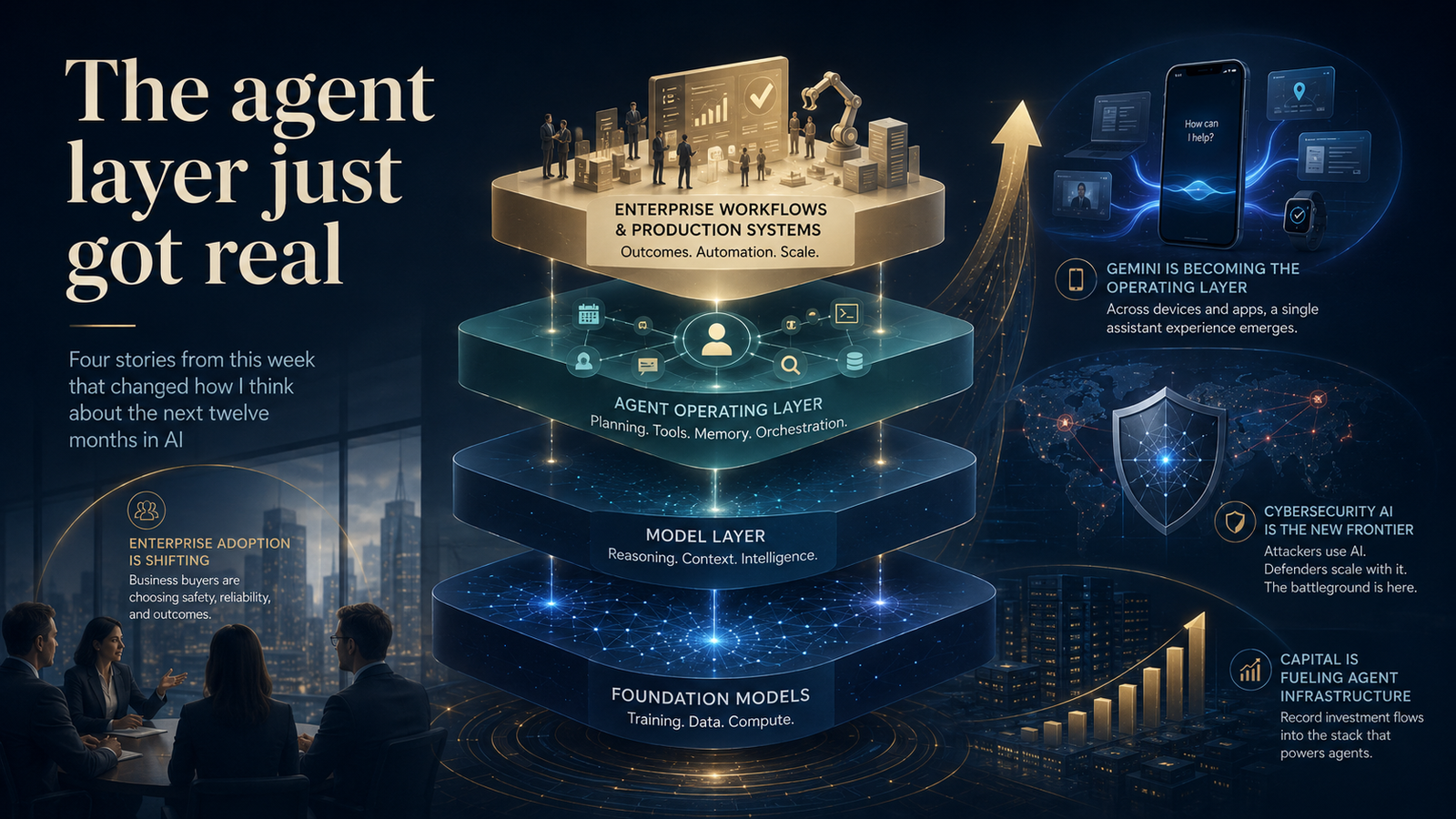
Four stories from this week that changed how I think about the next twelve months in AI.

Most weeks of AI news feel like noise. This one didn’t.
A few things happened that changed how I think about the next twelve months. Anthropic quietly overtook OpenAI in business adoption. Google stopped pretending Gemini is a chatbot. And the cybersecurity AI race went public, with OpenAI and Anthropic now openly building offensive and defensive models for enterprise security teams.
I write this from a builder’s seat. I run SocialCrawl, a search engine for what people actually say across social platforms. Before that, I was an AI transformation consultant, helping enterprises figure out where AI fits inside their operations. That work made one thing very obvious: the companies winning right now are the ones building the agent layer, not the ones shipping the next model.
Here is what stood out.
For the first time, more businesses are paying for Anthropic than OpenAI. Ramp’s May AI Index, drawn from expense data across more than 50,000 companies, shows 34.4% of its clients paying for Anthropic, versus 32.3% for OpenAI.

Figure 02The boardroom rotation: enterprise buyers are quietly choosing Anthropic.
A year ago, Anthropic was at 9%. That is not a small shift. It is a category-leading rotation driven by tech, finance, and professional services. Ramp’s economist Ara Kharazian put it simply: Anthropic started with a technical customer base, executed for them, then expanded outward through tools like Cowork.
Two days later, Anthropic announced a $200 million partnership with the Gates Foundation, covering global health, education, and life sciences over four years. The work targets polio, HPV, and preeclampsia. HPV alone causes about 350,000 deaths a year, and 90% of those are in low- and middle-income countries.
I am not naive about brand strategy. But this is a serious bet on AI doing work that markets do not pay for. It also gives Anthropic something OpenAI does not have right now: a credible public-interest story to attach to its model. If you are an enterprise buyer, that combination is a much easier internal sell than benchmark wins.
Ahead of Google I/O, Google announced that Gemini is no longer just a chatbot inside Android. It is the layer that moves between apps, reads what is on the screen, and finishes tasks for you.

Sameer Samat, who runs Android, gave a real example: ask Gemini to look at the guest list for a barbecue, build a menu, add ingredients to an Instacart list, then come back for approval before checkout.
Android Auto is in more than 250 million cars, and Google is redesigning that experience around Gemini too. The rollout starts on Samsung Galaxy and Pixel this summer, then expands to watches, cars, glasses, and laptops later this year.
Apple is expected to show its own Apple Intelligence reboot at WWDC, with parts of it running on Gemini under the hood. The frontier model race has narrowed to a few labs. The distribution race is now happening inside the phone.
For founders, this is the lesson I keep coming back to. Models are commoditizing fast. The moat is where the agent lives, what it can see, and what it can act on.
On May 11, OpenAI launched Daybreak, a cyber defense platform built on GPT-5.5-Cyber and Codex. It is meant to find vulnerabilities, validate patches, and operate inside enterprise codebases.

Figure 04The cyber AI race is now a hardware-scale problem, not a model-feature problem.
The same week, Anthropic continued positioning Mythos, its more sensitive cyber-intelligence model, as something it shares only with a small group of trusted partners. The European Commission is in talks with both labs about access.
Two different bets. OpenAI is building a scalable platform for vetted defenders. Anthropic is treating its cyber model as a national-security-grade asset.
I have one practical concern. The labs argue that defenders win in the long run, because security tooling has historically helped them more than attackers. That assumes the cheaper, less safe clones do not arrive first. I do not think anyone, including the labs, has a strong answer for what happens in that gap.
Funding this week was loud, and pointed at one thing: the infrastructure to run agents in production.

Sierra raised $950 million at a valuation above $15 billion. Their agents handle billions of customer interactions, and more than 40% of Fortune 50 companies now use them. They just launched Ghostwriter, a way to build new agents in natural language.
Exaforce raised a $125 million Series B at a reported $725 million valuation. Their pitch is agentic security operations: a real-time knowledge graph plus AI agents that triage and respond to threats in under a minute. Total raised so far: $200 million.
Judgment Labs raised $32 million across seed and Series A, both led by Lightspeed. They help teams turn production data into continuously improving agents. Their bet is that evaluation is the hardest problem in the agent stack.
White Circle raised $11 million from a backer list that includes leaders at OpenAI, Anthropic, Mistral, and Hugging Face. They sit between users and AI models, enforcing company-specific policies in real time. They have processed more than a billion API requests, and are already used by Lovable, the vibe-coding startup.
If you map this out, the agent stack got fully populated in a single week. Production agents (Sierra). Security agents (Exaforce). Quality and improvement loops (Judgment). Runtime safety (White Circle). This is what shipping AI to enterprises actually looks like in 2026.
The pattern is clear. Models are still improving. But the value is moving up the stack, into where agents live, what they can do, and how you control them.
Enterprises do not buy a model. They buy a system that gets work done, with policies, audit trails, and a way to make it better over time. The Anthropic shift is partly because they spent the last year being easier to deploy inside that kind of system. Google’s Gemini push is the same idea, applied to consumer devices. The funding rounds are everyone else racing to fill the gaps in between.
If you are building in AI right now, do not get distracted by which model wins this quarter. The real question is whose agent layer your customers will live inside, and what is left for you to build on top that they actually need.
I do not have a clean answer to that yet. After this week, I have a much sharper sense of where to look.
This week, the AI industry moved beyond ambitious claims. OpenAI published machine-checkable proofs, model prices fell, autonomous agents…
Three teams released models above 900 billion parameters in a single week. The interesting question is not the…
GPT-5.6 solves a 50-year math problem. An AI agent raises $100 million. And Congress wants to know who…