Physical Address
304 North Cardinal St.
Dorchester Center, MA 02124
Physical Address
304 North Cardinal St.
Dorchester Center, MA 02124
Ownership, regulation, drug discovery, infrastructure. Four stories that prove AI is no longer just a technology question.
By Woosub Kim · 5 min read · July 6, 2026

I spent most of my consulting career helping enterprises figure out what AI could do for them. Strategy decks, implementation roadmaps, ROI projections. The question was always “how do we use this tool?” This week, the question changed. It is no longer about the tool. It is about who owns the tool, who regulates it, and whether those should be the same people.
Four stories from the past ten days made that shift impossible to ignore.

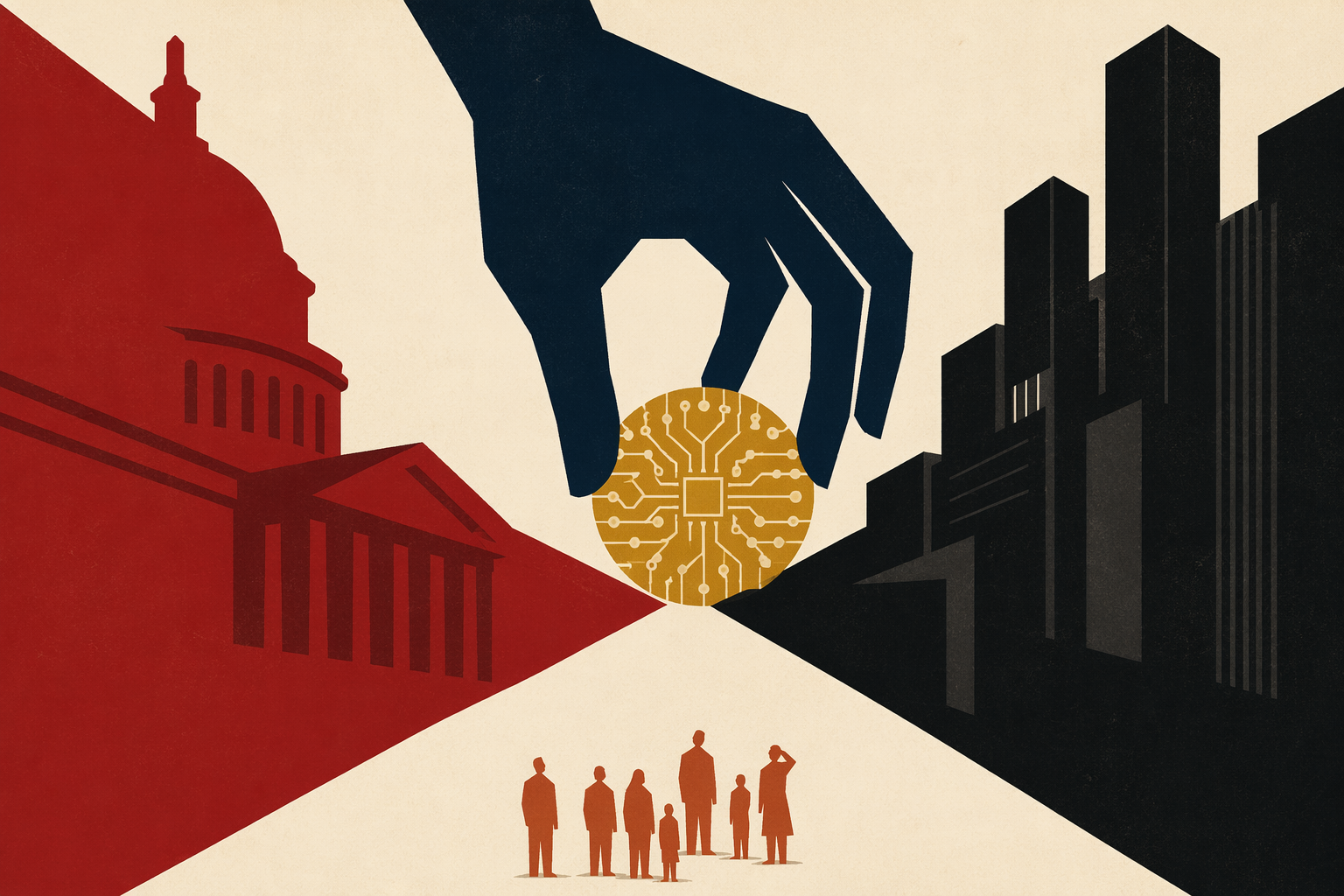
Sam Altman proposed giving the US government a 5% equity stake in OpenAI. At the company’s current $852 billion valuation (set in the March 2026 funding round), that slice is worth roughly $42.6 billion. No taxpayer money changes hands. The stake would be donated.
The pitch borrows from the Alaska Permanent Fund, the state-owned vehicle that invests oil revenue and pays dividends to residents. Altman wants every leading US AI developer, including Google, Anthropic, Meta, and xAI, to contribute 5% of their equity to a similar federal fund. Applied across the industry, the combined public stake could reach hundreds of billions.
“A government that holds $42.6 billion in OpenAI stock has a direct financial incentive to write regulation that protects OpenAI’s valuation. That is not oversight. That is a conflict of interest wearing a policy hat.”
$852B
OpenAI valuation
$42.6B
Proposed gov. stake
5%
Equity per AI lab
Nat Purser at Public Knowledge put it plainly: every safety rule that reduces revenue also reduces the value of the government’s own portfolio. Forrester analyst Indranil Bandyopadhyay flagged a second risk. Enterprise buyers in Europe and Asia-Pacific will reassess their data sovereignty assumptions about US AI providers once Washington holds a direct financial stake. Other governments may demand analogous equity deals as a condition of market access.
The proposal is still conceptual. Congress has not signaled appetite for it. But the signal itself matters: the CEO of the most valuable AI company on Earth just said the word “regulate” is the wrong frame, and “co-own” is better. That is a sentence worth sitting with.

OpenAI previewed GPT-5.6 Sol on June 26. Anthropic launched Claude Sonnet 5 on June 30. Two frontier model drops, four days apart.
GPT-5.6 comes in three tiers: Sol (flagship), Terra (balanced, cost-efficient), and Luna (lightweight). Sol leads on reasoning and agentic capability, with notable improvements in coding, biology, and cybersecurity benchmarks.
Claude Sonnet 5, meanwhile, is Anthropic’s most agentic Sonnet to date. It plans, uses tools (browsers, terminals), and operates autonomously for longer stretches. Anthropic says it narrows the gap with their own Opus line while costing less to run.
The pattern is clear. Both labs are racing toward the same destination: models that do not just answer questions but actually complete work. Browse, code, research, file, iterate. The model itself is becoming less of the product and more of the runtime. The differentiation is shifting to the ecosystem around it, the tooling, the integrations, the trust layer.
For builders, this is good news. The floor for model quality keeps rising. For investors betting on a single model provider as a permanent moat, the picture is more complicated. When two labs ship comparable agentic capability in the same calendar week, the moat is not in the model weights.

This was the story that made me stop scrolling. On June 30, Anthropic announced two things simultaneously. First, Claude Science, a multi-agent workbench for reproducible scientific research with 60-plus pre-configured tools and connectors for genomics, proteomics, and cheminformatics pipelines. Second, an internal drug development program where Anthropic will run its own pharmaceutical research using Claude Science.
Read that again. An AI model company is now doing its own drug discovery. Not partnering with pharma. Not licensing the model to Pfizer. Running the pipeline internally.
“If one AI lab can vertically integrate into drug discovery, what stops another from doing it in materials science, climate modeling, or financial engineering?”
This is a fundamentally different business model from selling API tokens. Anthropic is betting that Claude Science can compress the drug development timeline enough that the upside of owning the discoveries outweighs the revenue from selling access. If the bet works, Anthropic becomes a hybrid: part model lab, part biotech.
The precedent matters more than the program itself. The “picks and shovels” narrative, the idea that AI companies will stay neutral infrastructure providers, may be running out of runway.

Together AI raised an $800 million Series C at an $8.3 billion valuation, led by Aramco Ventures with participation from Nvidia, Vista Equity, and General Catalyst. The company rents GPU clusters and runs open-source models for enterprises that want capability without the frontier-model price tag. Annual bookings have crossed $1.15 billion.
Together AI is one data point in a broader wave. Upscale AI raised $500 million last month. TensorWave (AMD-focused GPU clusters) raised $350 million. The neocloud market, companies that sit between the hyperscalers and the end customers, is absorbing billions.
The demand side is real. Enterprises are figuring out that 80% of their AI workloads do not need a frontier model. Open-source alternatives running on cheaper infrastructure get the job done. The neocloud providers are the ones making that trade-off easy.
Meanwhile, the regulatory clock keeps moving. The EU AI Act’s general-purpose AI enforcement powers switch on August 2, 2026. Fines can hit 15 million euros or 3% of annual global turnover. US-based firms built 40 of the 61 notable AI models tracked in the 2025 Stanford AI Index, so this is materially a US-facing deadline. Gartner says 63% of organizations either lack the right data management practices for AI or do not know whether they have them.
And in California, Governor Newsom struck a deal with Anthropic for all state and local government agencies to use Claude at half price. The federal government designated Anthropic a “supply-chain risk” and awarded its defense contract to OpenAI instead. Same company, two branches of government, opposite conclusions. That is the regulatory environment in mid-2026.
The Honest Take
I do not have a clean conclusion here, and I am suspicious of anyone who does. The AI industry is reorganizing itself around questions of ownership, vertical integration, and regulatory capture at a pace that makes neat frameworks feel dishonest.
What I do know: the builders who are paying attention to the power dynamics, not just the model benchmarks, are the ones who will make better decisions in the next twelve months. The model is the easy part now. The hard part is everything around it.
This week, the AI industry moved beyond ambitious claims. OpenAI published machine-checkable proofs, model prices fell, autonomous agents…
Three teams released models above 900 billion parameters in a single week. The interesting question is not the…
GPT-5.6 solves a 50-year math problem. An AI agent raises $100 million. And Congress wants to know who…