Physical Address
304 North Cardinal St.
Dorchester Center, MA 02124
Physical Address
304 North Cardinal St.
Dorchester Center, MA 02124
Most people still type every question into Google. Work questions, research questions, “what do people actually think about this” questions. All into the same box.
That habit is starting to fail. The best AI search engines aren’t trying to replace Google. They’re carving out specific jobs Google was never great at: quick explanations, evidence-based research, real public opinion, code, buying decisions. So the real question isn’t “what’s the best search engine.” It’s “best AI search engines for what?” Get that right, and you’ll save hours every week.
Here’s the stack worth knowing in 2026.
Before you type anything, ask one question: what kind of answer do I actually need?
There are basically five types: a website, an explanation, evidence, a product, or what real people are saying. Pick the wrong tool for the job and you’ll get a clean-looking answer with the wrong signal. Marketers do this all the time. They Google “what do customers think about [product]” and read SEO blog posts written for Google. Then they wonder why their messaging is off.
The fix is simple. Match the question to the tool.
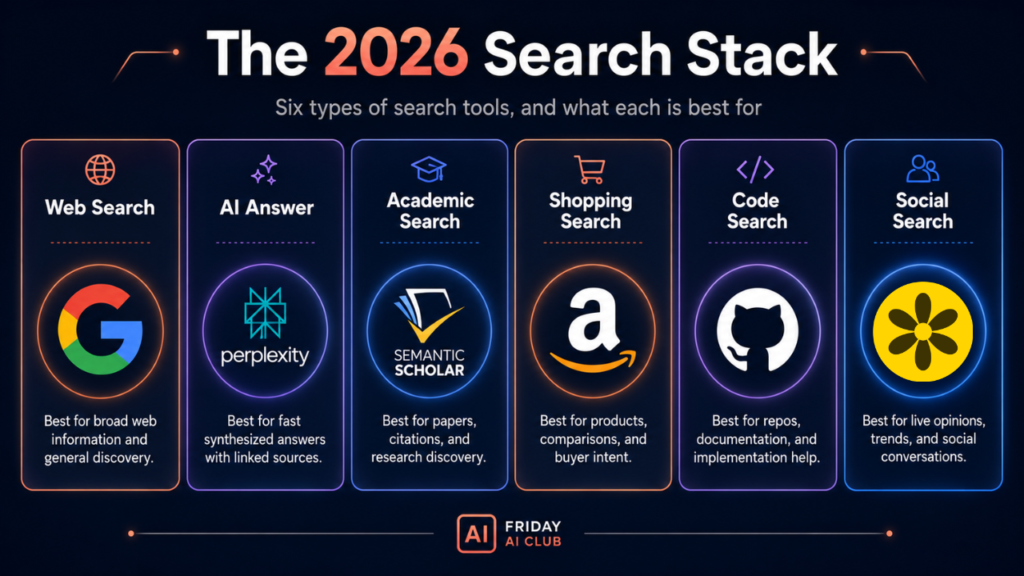
Here are the best AI search engines and traditional engines worth keeping in rotation, sorted by what they’re actually good at.
Best for: Finding websites, official sources, news, maps, local businesses.
Use when: You already know roughly where the answer lives. “What’s the address of this company?” “What did they announce this morning?”
Blind spot: Results are dominated by SEO content. You see what websites say, not what people think.
Best for: Quick explanations, comparisons, summaries, structured thinking.
Use when: You want to understand a concept fast or draft an outline. “Explain how X works.” “Compare A vs B for someone in role Y.”
Blind spot: AI answers can sound confident even when wrong. Sense-check anything that matters.
Best for: Peer-reviewed evidence, citations, research papers.
Use when: You’re writing anything that has to hold up under scrutiny. Health claims. Strategy decks. Investment memos.
Blind spot: Useless for live trends or what’s happening in the market right now.
Best for: Comparing tools, reading reviews, finding alternatives.
Use when: You’re choosing software, checking competitors, or buying anything.
Blind spot: Reviews come from a narrow slice of users. Not the whole story.
Best for: Code examples, error messages, API references, implementation help.
Use when: You’re building something and need a working answer, not theory.
Blind spot: Strong on the “how,” weak on the “should we even build this.”
Best for: Real conversations across social platforms. Pain points, complaints, opinions, audience language.
Use when: You need to know what actual humans are saying about a topic, not what websites publish about it.
Blind spot: Not the place for facts or formal evidence. Use it for signal, not citation.
This last one is the gap most people don’t realize they have. Google shows what websites say. AI search explains what information means. Social search shows what people actually think. Three different layers of truth, and most workflows only use one.
You don’t need all six tools every day. Here’s what tends to work for different jobs.
Founders: Google for market basics, Perplexity for synthesis, SocialCrawl for customer pain points. The pain points are where your product actually wins.
Marketers: AI search for campaign planning, G2 or Product Hunt for competitor research, SocialCrawl for how audiences actually talk about your category. Your copy gets sharper when you steal the language from real conversations.
Students: AI search for explanations, Scholar for evidence. Use the AI to understand the topic, then back the claims with papers.
Researchers and analysts: Scholar for evidence, AI search for summaries, social search for what’s happening on the ground. The combination of formal and informal signal is where good research lives.
The pattern is the same across roles. Start with the question, then pick the tool that gives you the right kind of signal.
Use Google when you need a website. Use ChatGPT or Perplexity when you need an explanation. Use Scholar when you need evidence. Use G2 when you need to buy. Use GitHub when you need code. Use SocialCrawl when you need real conversations.
The best AI search engines aren’t fighting for the same job. Each one is better at one specific thing. The best search engine isn’t the most popular one. It’s the one that gives you the right signal for the decision you’re actually trying to make.
The model wars are still on. But this week, the real battleground shifted to deployment. June 1, 2026…
Weekly Briefing The Big Four bet 750,000 seats on Claude. A Fields Medalist says GPT did PhD-level math…
Most brands know they should be listening to what people say online. Very few actually do it well.…