Physical Address
304 North Cardinal St.
Dorchester Center, MA 02124
Physical Address
304 North Cardinal St.
Dorchester Center, MA 02124
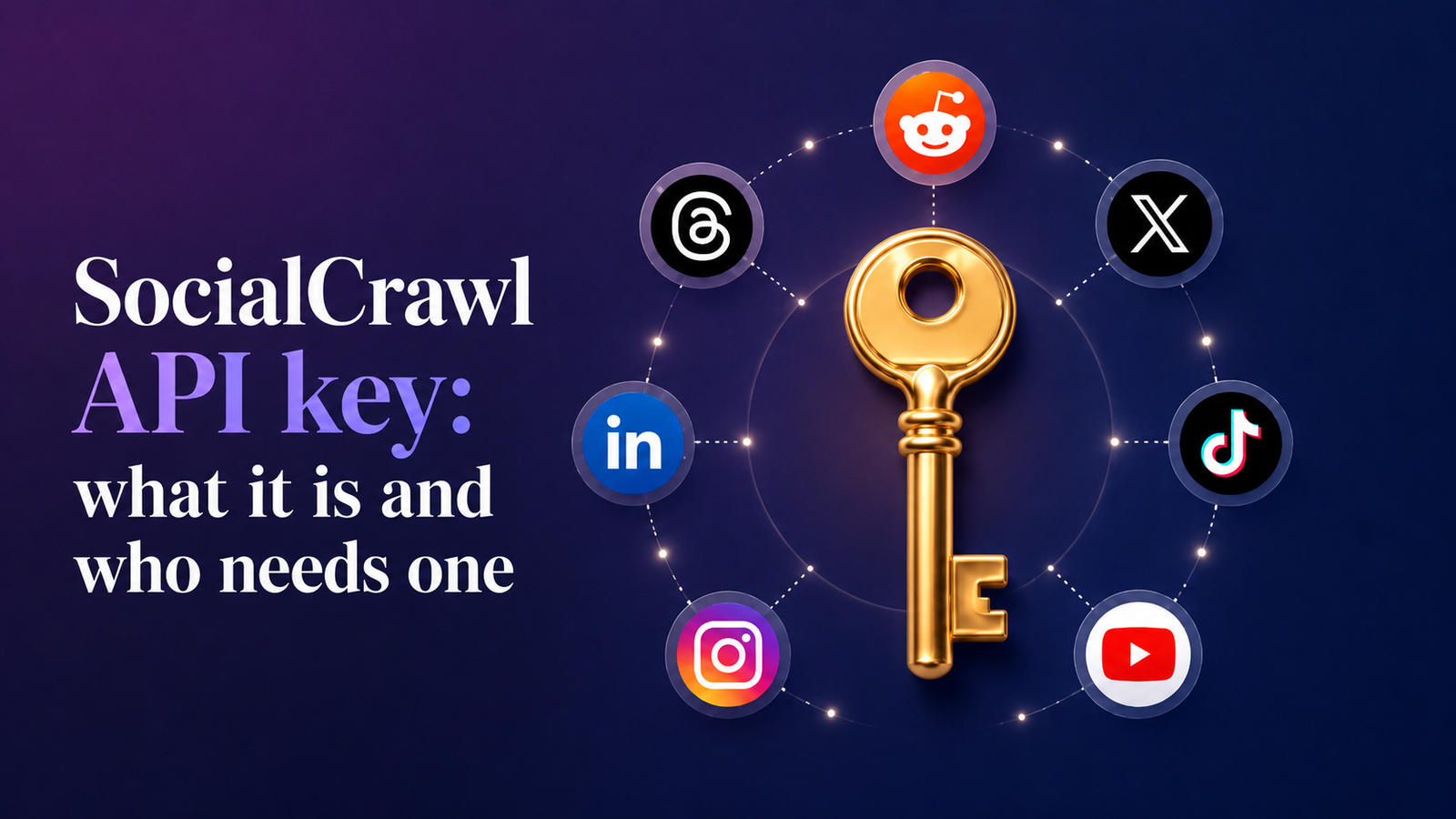
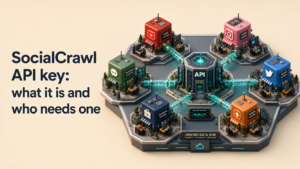
If you’ve ever tried to pull data from Reddit, then YouTube, then TikTok, then X, each with its own login flow, rate limits, and half-broken developer docs, you already know the problem the SocialCrawl API key is built to solve. One key, 21+ social platforms, clean data back.
That’s the pitch. Below is the honest version: what a SocialCrawl API key is, who it’s actually for, and what kind of work you can get done with it without needing a backend engineer.
An API key is a string of characters (it looks something like sc_live_a8f3...) that proves to a service it’s really you making the request. Every developer tool uses them. Think of it as a username and password collapsed into one line of text.
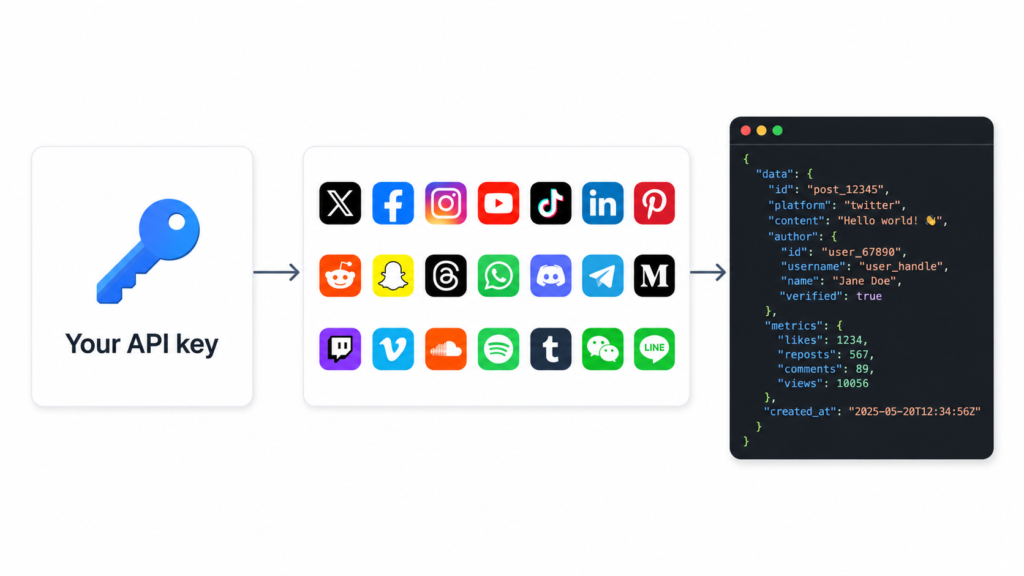
What’s unusual about the SocialCrawl API key is that it works as a single credential across every social platform the service supports. You don’t sign up for Twitter’s Developer Portal, then wait two weeks for Instagram’s Graph API approval, then learn YouTube’s quota system. You sign up once, get a key, and that key gives you access to public data from Reddit, X (Twitter), Instagram, TikTok, YouTube, LinkedIn, Threads, Facebook, Pinterest, Twitch, Bluesky, and a handful more.
The other thing worth knowing: the data comes back in a clean, structured format. You’re not parsing raw HTML or guessing what data.children[0].edge_owner_to_timeline_media means. You ask for a profile, you get a profile object back. Same shape across platforms, more or less.
Honest answer: not everyone. If you’ve never opened a developer dashboard and don’t plan to, you probably don’t need one yet. But there are a few groups who get real value out of one.
Indie founders and solo builders use it to validate product ideas. The most common move is searching Reddit and Hacker News for people describing a problem in their own words, then deciding whether to build a tool for them. Pain-point mining, basically.
AI agent builders plug the SocialCrawl API key into their Claude, n8n, or LangChain setups so the agent can pull fresh social data on demand. ChatGPT and Claude can’t natively read Reddit comments or X posts. With a SocialCrawl API key, your agent can.
B2B marketers and growth teams use it to track competitors across platforms, monitor brand mentions, and work out what kind of content is landing in their niche. It replaces the “I’ll just check each platform manually for 90 minutes” workflow.
Agencies run it across multiple client accounts, feeding dashboards, generating reports, and doing influencer research without paying enterprise-tier prices to Hootsuite or Meltwater.
Researchers and journalists use it to gather public posts for analysis (sentiment, narrative tracking, OSINT work) without learning each platform’s auth flow.
If you recognised yourself in any of those, the next section is for you.
The list is long, but a few use cases come up over and over.
Pre-meeting intel is a popular one. Before a sales call or a podcast interview, you can pull the other person’s recent X posts, podcast appearances, GitHub activity, and any Reddit threads about them, all in maybe 30 seconds. Way more current than a LinkedIn profile.
Audience research is another. If you’re writing for content marketers, you can scrape r/content_marketing and r/marketing for the exact phrases your audience uses to describe their problems. Plug those into your headlines, and your copy stops sounding like every other LinkedIn post.
Competitor monitoring is the unsexy but genuinely useful one. Set up a workflow that pulls your top three competitors’ posts every Monday morning. You see their launches, their angles, their engagement patterns, without paying $99/month for Hootsuite Insights.
And then there’s the AI-agent stuff. If you’re building an automation in n8n that, say, drafts a weekly newsletter summarising trends in your industry, the SocialCrawl API key is the part that fetches the actual social data. Your agent does the synthesis.
There’s a whole category of “research before you build, write, or launch” workflows this enables, and they’re the ones I keep coming back to.
The free tier covers most people who are just trying it out. Sign up at socialcrawl.dev to receive 400 free credits, no credit card required.
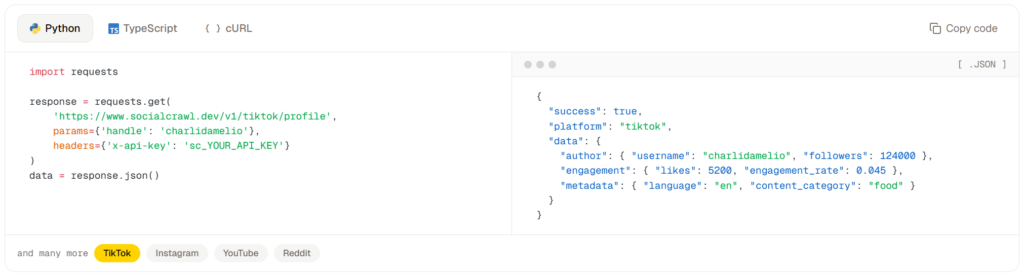
From there, you’ve got three main on-ramps.
If you write code, paste the key into a curl or Python script and you’re calling the API in under a minute.
If you don’t write code, drop it into an n8n workflow node and connect the output to wherever you want the data to land: a Google Sheet, an email, a Slack channel.
If you live inside Claude or another AI assistant, the SocialCrawl MCP server lets you wire the key in once and then ask the assistant in plain English (“pull the top 10 Reddit posts about AI agents from this week”). The assistant handles the API call for you.
A SocialCrawl API key isn’t magic. It won’t write your content for you, fix a bad product, or replace actual judgement. What it does is collapse a research workflow that used to take an hour into something that takes a couple of minutes, and it gives AI agents access to the social web they otherwise can’t see.
If you’re doing serious work that involves what’s happening on social platforms right now (research, content, monitoring, building tools), a SocialCrawl API key earns its keep. If you’re not, you’re better off saving the headspace.
Next up in this series: a walkthrough of the first thing most people try with their new key, which is pulling Reddit data to find content ideas. That’s the post where it stops being theory.
Most brands know they should be listening to what people say online. Very few actually do it well.…
One API key, one response format, 27 platforms. Here is what developers are actually shipping with it. Figure…
Building is a blast until reality hits It's 2026, product building is EASY. Claude Code, Codex, OpenClaw, Hermes…