Physical Address
304 North Cardinal St.
Dorchester Center, MA 02124
Physical Address
304 North Cardinal St.
Dorchester Center, MA 02124
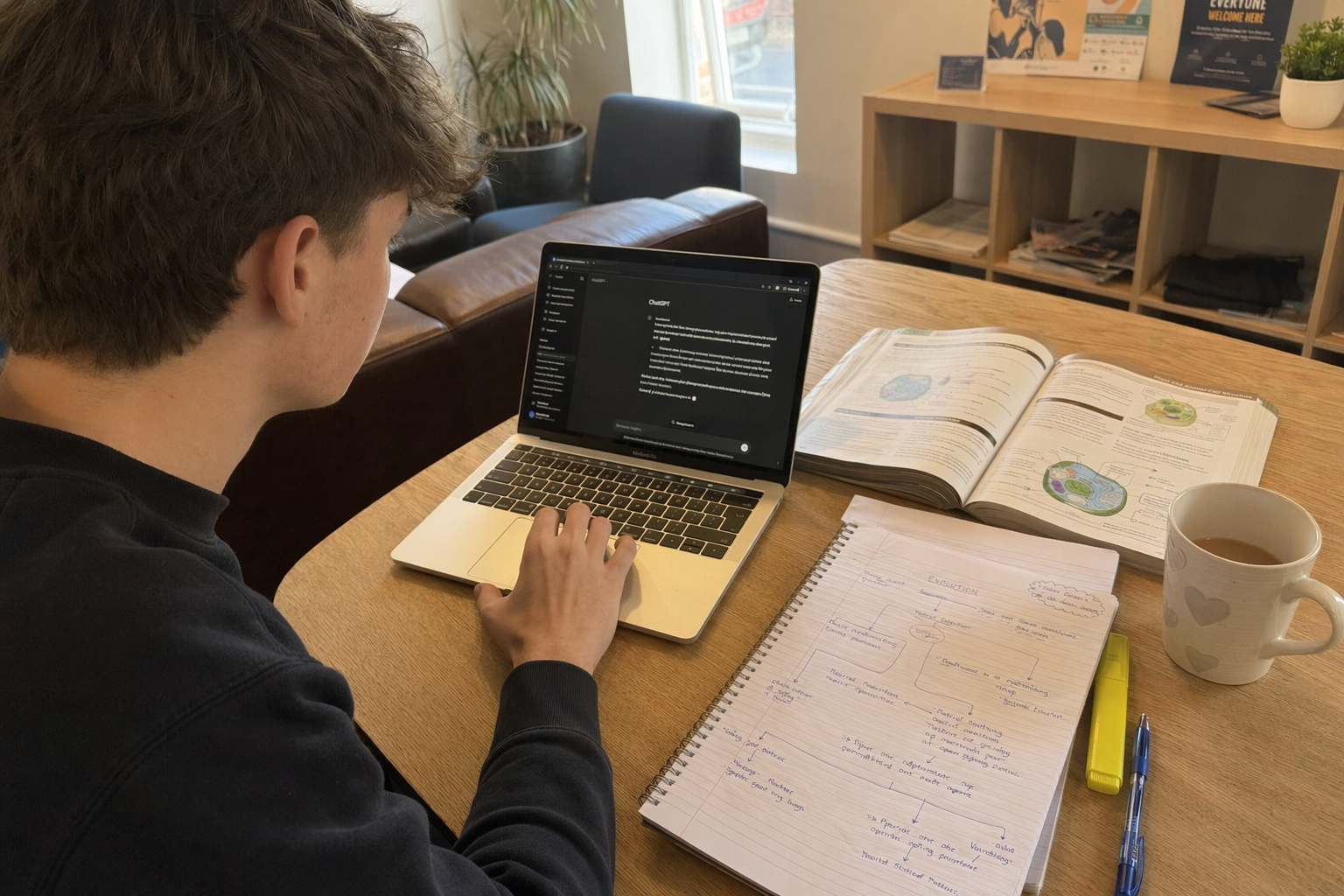
If you are a UK student in 2026, ChatGPT is already on your phone and somewhere in your group chat. The question is not whether to use it, but how to use it without getting disqualified, dumbed down, or outpaced by classmates who know the prompts you do not.
This guide is written for UK students. We cover JCQ rules for GCSEs and A-levels, what Russell Group universities allow, how UCAS treats personal statements that smell of AI, and what ChatGPT Plus actually costs in pounds.
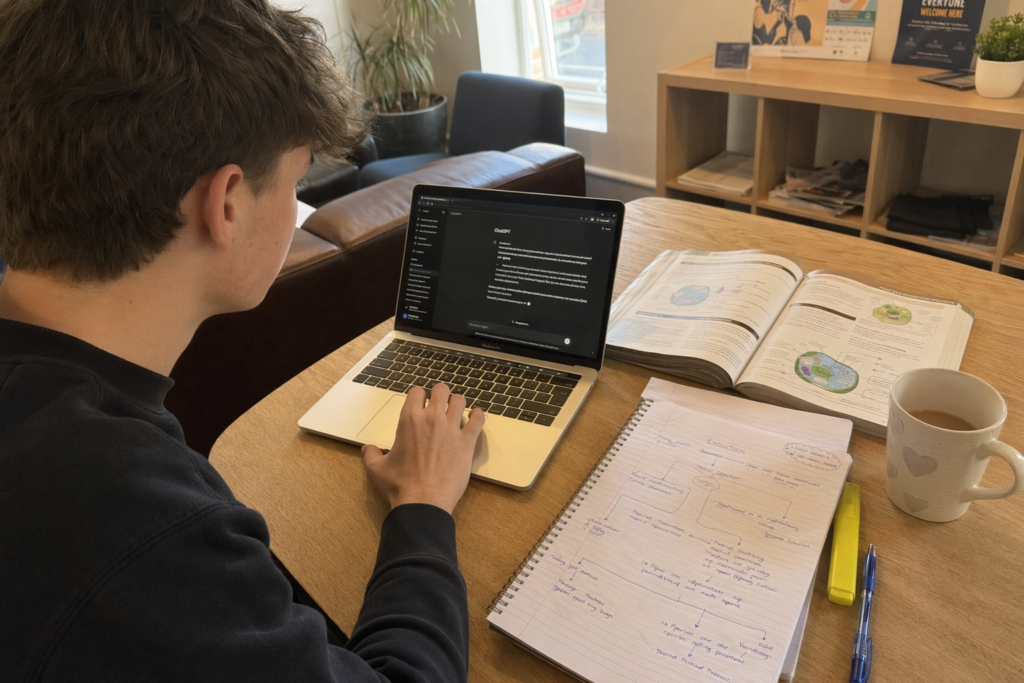
ChatGPT is a large language model built by OpenAI that you chat with in plain English. You type a question or paste in some text, and it responds in seconds. The free version is useful. The paid version (ChatGPT Plus) adds voice mode, file uploads, image generation, deeper reasoning models, and a feature called Study Mode that we will come back to.
Adoption among UK students has been dramatic. According to the HEPI Student Generative AI Survey 2025, 92% of UK undergraduates now use generative AI in some form, up from 66% a year earlier. At secondary level the picture is similar, with 93% of UK GCSE, A-level, IGCSE and IB students reporting AI use for schoolwork in Save My Exams’ 2026 AI in Education statistics, which surveyed 1,533 UK pupils.
ChatGPT is the clear favourite, with 87% of UK students who use AI for study using ChatGPT specifically, Gemini at 38% and Microsoft Copilot at 26%. When British students say “AI”, they usually mean ChatGPT. That dominance shapes how teachers, exam boards and universities frame their guidance.
Straight answer: it depends on what you do with it.
The Joint Council for Qualifications (JCQ), which oversees GCSEs and A-levels across England, Wales and Northern Ireland, prohibits AI-generated content in Non-Examination Assessments and coursework. Submitting text that ChatGPT wrote as your own is malpractice, and at worst costs you the qualification. AQA, OCR and Edexcel all align with that. They accept AI as a study tool, but anything submitted for a grade must be your own work.
University rules are similar but more nuanced. The University of Oxford’s AI Use in Summative Assessment policy permits AI in summative work only when course or exam instructions explicitly allow it, with a declaration. Cambridge expects you to declare AI use. Imperial College London published departmental generative AI principles in March 2025, as documented in Thesify’s tracker of university AI policies. UCL and King’s have similar frameworks. The Russell Group pattern is consistent: AI to learn, fine; AI to write your submission, not fine without permission and disclosure.
The good kind of use: explaining concepts, summarising reading, generating practice questions, brainstorming essay angles, or checking grammar on writing that is already yours. Broadly analogous to using a textbook or a friend who happens to be good at the subject. Risky use: asking ChatGPT to draft your essay, coursework, or personal statement and submitting that as your own.
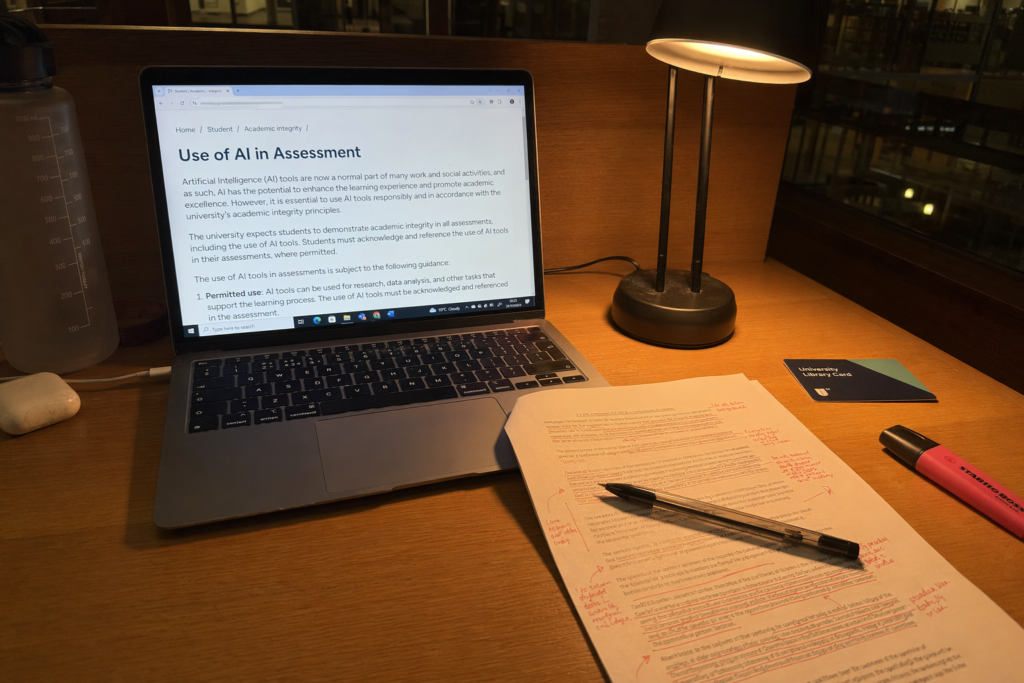
The detection question complicates things. One Plos One study cited by Save My Exams found that 94% of AI-written academic submissions went undetected in a university examination system. That sounds like a green light. It is not. UK universities including Northumbria and University of the Arts London actively deploy detection tools and look for behavioural tells: sudden style shifts, polished prose, missing personal voice. The longer you rely on AI for output, the less you learn. In a closed-book exam hall, ChatGPT cannot help you.
If your aim is real learning, ChatGPT is most useful as an active study partner, not a passive answer machine. A few patterns:
Exam-board-specific practice questions. Tell ChatGPT your exam board (AQA, OCR, Edexcel, WJEC), tier (Foundation or Higher), and topic. Try: “Generate 5 GCSE AQA Biology questions on cell division, Higher tier, with mark-scheme style answers and command words highlighted.” Not a perfect mark scheme, but useful practice. Cross-check against your specification.
Use Study Mode. OpenAI’s ChatGPT Study Mode turns the model into a Socratic tutor that asks questions instead of handing you answers. An MIT Media Lab EEG study in June 2025, tracking 54 students, found that those who wrote essays using ChatGPT showed the weakest neural connectivity across memory and engagement brain bands, and most struggled to recall their own essays shortly after writing them. Study Mode counteracts exactly that: it forces retrieval rather than outsourcing it.
Eighty-eight percent of UK university students now use AI for assessment-related tasks (explaining concepts, summarising articles, suggesting research angles), up from 53% the previous year, per the HEPI 2025 figures. You are not unusual. You just need to use it in ways that deepen your work rather than replace it.
Start with the policy. Open your module handbook, your course AI policy, and your university’s academic integrity guidance. If the answer to “is this allowed?” is “I do not know”, treat it as not allowed until you have asked your tutor. A short email beats a panel hearing.
For research, use ChatGPT to scope a topic and identify key concepts, then verify everything with a real database (Google Scholar, your university library, JSTOR, PubMed). Treat any reference ChatGPT gives you as unverified. It hallucinates citations. Perplexity AI is better when you need sourced references, because it links to real pages.
For writing, use it as an editor rather than a ghostwriter. Paste your own draft and ask: “Suggest where my argument is weakest in this paragraph, and what counter-argument I have not addressed.” That kind of pushback keeps the writing yours. Avoid: “Write me 500 words on X.” Almost every UK university now flags submissions that read like that.
For coding modules, ChatGPT is a fast debugging partner. Paste a Python error, ask it to explain (not just fix) what is wrong, and you will actually learn the language. Several Computer Science programmes now assess the quality of your prompting and verification, not the absence of AI.
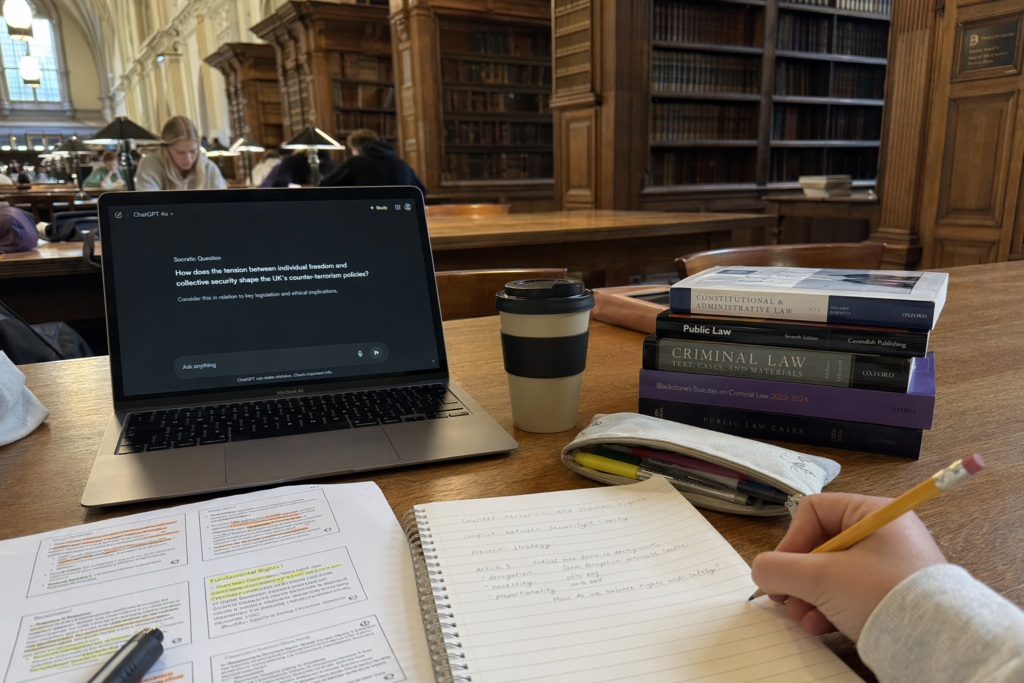
This is the question that should worry Year 12 and Year 13 students more than any other, because the stakes are immediate. UCAS introduced AI detection checks on personal statements in 2024. Applications flagged as likely AI-generated can be rejected, and offers can be withdrawn after the fact. The risk is real and asymmetric: a slightly slicker statement in exchange for your university place.
What works is using ChatGPT for the parts of the process that are not the writing itself. Brainstorm experiences you might mention, ask what universities typically value in a personal statement for your subject, get feedback on a draft you have written, or check grammar on your own sentences. All fine.
What does not work is pasting in a prompt like “Write me a 4,000-character personal statement for studying Economics at LSE” and submitting whatever comes back, even lightly edited. UCAS-trained reviewers and AI detectors both pick up on the same tells: generic openers, balanced symmetry, lack of specific personal detail, no real institution-specific reflection. If a sentence could have been written by any applicant in the country, it probably will be flagged as such.
A safer workflow: draft your statement entirely yourself, ideally with notes from your teachers and your supercurricular activities. Then ask ChatGPT for targeted feedback: “Where does my argument feel weakest? Which paragraph is the most generic? What questions might an admissions tutor ask after reading this?” Rewrite in your own words. Your voice stays yours, the structure tightens up, and detection tools have nothing distinctive to catch.
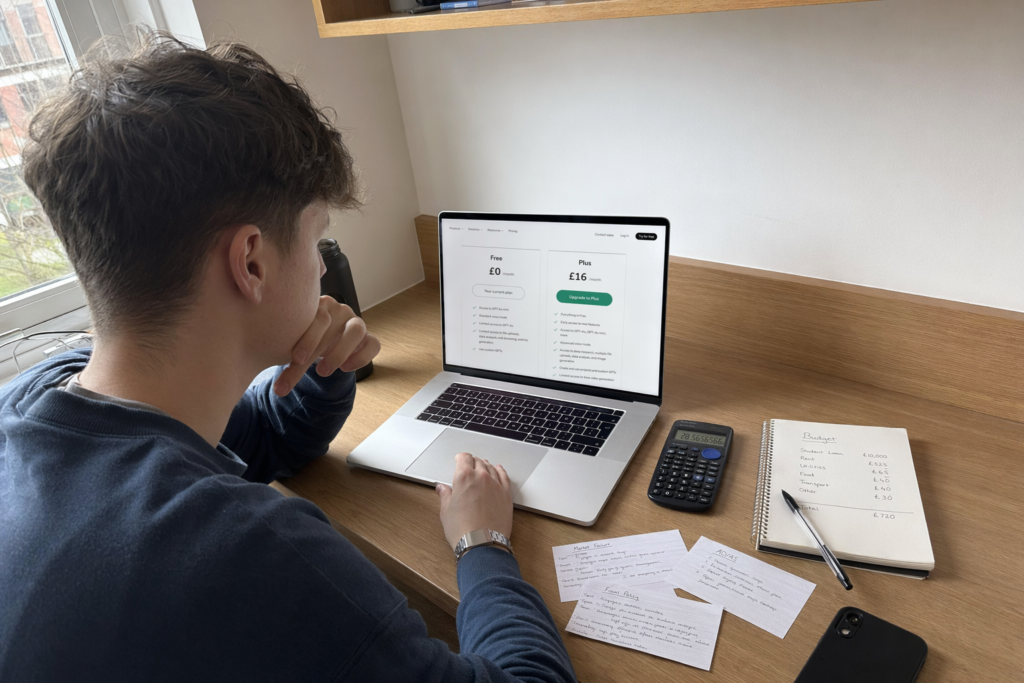
ChatGPT Plus costs roughly £16 per month in the UK (based on the $20 list price plus VAT, so always check the current GBP figure at checkout). That works out at about 50p per day, or around £192 a year. For most students, that is comparable to one private tutoring session, so the maths is not absurd.
Whether it is worth it depends on how heavily you study. The free tier is useful and will cover light revision needs. You get access to a capable model, basic chat, and enough usage for most students who dip in once or twice a day. Plus is worth considering if you want Study Mode for active revision, voice mode for hands-free quizzing on your commute, file uploads for lecture notes and PDFs, and access to the latest reasoning models, which produce noticeably better answers on complex maths, physics and essay work.
A pragmatic approach: stay on the free tier through term time, then upgrade for the two months around your exam window. The Plus features matter most when you are deep in revision rather than still learning new material.
There is no official student discount at time of writing. If cost is a barrier, Microsoft Copilot is free for students with a Microsoft account and is good. Google Gemini is free at its base tier and integrates with Google Docs. Khan Academy’s Khanmigo is free and uses a strict Socratic method, which is excellent for maths and science. You do not need to pay anyone to use AI well.
The biggest mistake is the one nobody talks about, because it does not feel like a mistake while you are making it. You feel productive. You finish faster. Then the exam comes, and you find out what you actually learned.
A randomised controlled trial cited in Coursiv’s 2026 review found students using ChatGPT completed tasks in an average of 3.2 hours, against 5.8 hours for traditional learners. Forty-five days later, a delayed recall test showed the ChatGPT users scoring 5.75 out of 10 against 6.85 for the traditional group. Faster output, weaker memory.
There is also a wider equity issue. Research from the Sutton Trust found that private school teachers are more than twice as likely to have received formal AI training as state school teachers (45% versus 21%). Students at well-resourced schools are learning to use these tools well; students elsewhere are working it out alone. That gap will show up in results.
A few habits to avoid:
Do not ask ChatGPT to mark your exam answers. It has not been trained on your specific AQA, OCR or Edexcel mark schemes and will reward fluent writing that misses the keywords that actually earn marks.
Do not cite ChatGPT as a source. Its references are frequently fabricated. The SafeTutors 2026 benchmark tested 11 large language models across maths, physics and chemistry and found every model exceeded a 60% harm rate on at least five pedagogical risk dimensions, with failure rates rising from 17.7% in single questions to 77.8% in multi-turn dialogues.
Do not skip verification. If ChatGPT gives you a fact or formula, cross-check it against your textbook. Two minutes saves you from quoting a hallucinated statistic in front of an examiner.
Do not let AI literacy training stay optional. Only 36% of UK university students have received any formal AI training from their institution, despite 67% saying AI use is essential, per HEPI. If your university offers a workshop, attend it.
It depends entirely on the task. Using ChatGPT to understand a topic, generate practice questions, brainstorm ideas, or check grammar on your own writing is broadly acceptable and treated similarly to using a textbook. Submitting ChatGPT-generated content as your own work in coursework, essays, NEAs, or assignments is academic misconduct under JCQ rules and at virtually every UK university. Always check your specific institution’s academic integrity policy, because the line shifts by module.
The Joint Council for Qualifications (JCQ) prohibits AI-generated content in formal coursework and Non-Examination Assessments. You should not submit anything written by ChatGPT as your own work. Using it to understand topics, brainstorm before you write, or improve your subject knowledge sits in a grey area that most schools tolerate. The safest position: use it to learn the material, write the actual submission yourself.
Quite possibly. UCAS introduced AI detection on personal statements in 2024, and applications flagged as AI-generated can be rejected or have offers withdrawn. Using ChatGPT to brainstorm ideas, get feedback on a draft, or check grammar on your own writing is generally safe. Asking it to write the statement for you is high risk and not worth it for the marginal polish.
The free tier covers most needs and is a sensible starting point. ChatGPT Plus (around £16 per month in the UK) adds Study Mode, voice conversations, file uploads, image generation, and access to the latest reasoning models. The pragmatic approach is to stay free during term time and upgrade for one or two months around exam season, then cancel. There is no official UK student discount at present.
No. A September 2025 meta-analysis of 42 empirical studies concluded that AI cannot replace teachers in assessment, performing acceptably on closed-ended tasks but failing on open-ended, subjective work that needs contextual judgement. ChatGPT also lacks the emotional read of a human tutor, who can notice when you are confused, anxious, or coasting. Treat AI as a supplement to a tutor, teacher, or revision group, not a substitute.
This week, the AI industry moved beyond ambitious claims. OpenAI published machine-checkable proofs, model prices fell, autonomous agents…
Three teams released models above 900 billion parameters in a single week. The interesting question is not the…
GPT-5.6 solves a 50-year math problem. An AI agent raises $100 million. And Congress wants to know who…