Physical Address
304 North Cardinal St.
Dorchester Center, MA 02124
Physical Address
304 North Cardinal St.
Dorchester Center, MA 02124
Choosing the best AI coding model can feel like comparing four pages of benchmarks written in four different languages. Every company says its latest model is stronger, faster or better value.
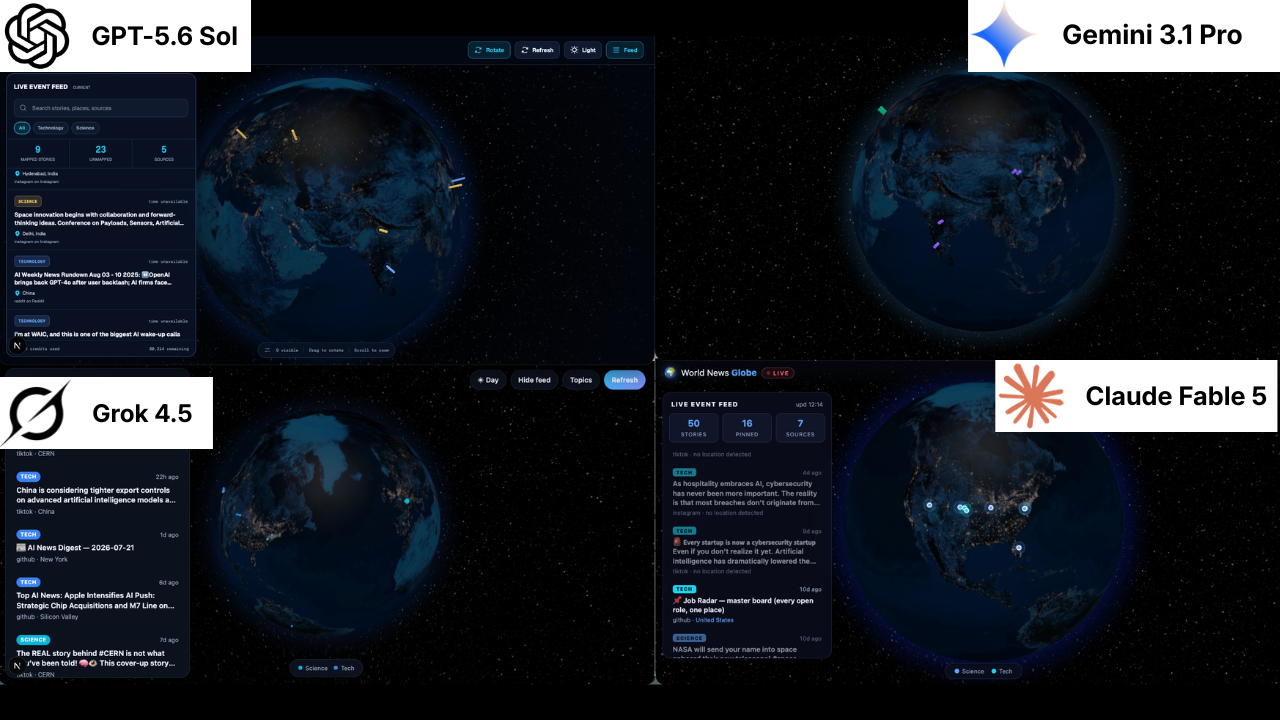
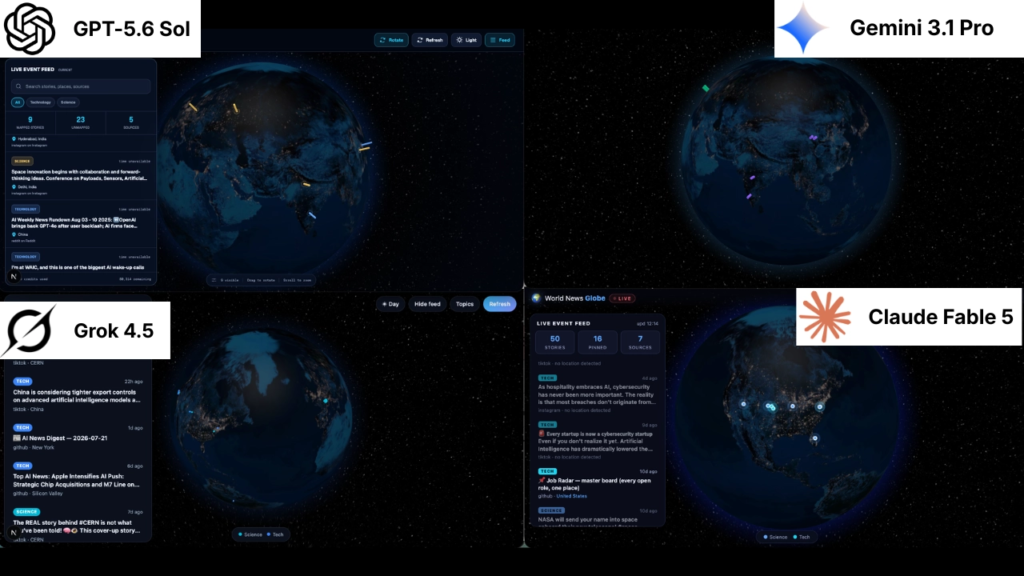
But benchmarks don’t tell you which model will work best for your workflow. So I gave Claude Fable 5, GPT-5.6 Sol, Grok 4.5 and Gemini 3.1 Pro the same app to build.
Each model got one prompt and no corrections. I hid the names and scored the results before looking at time or cost.
tldr: Fable won on polish, Sol on functionality, Grok on practical value and Gemini on measured run cost.
This article is for beginners and non-technical builders who want a clear way to choose an AI coding model without getting lost in benchmark charts.
| Model | Standout result | Time | Measured run cost | Main weakness |
|---|---|---|---|---|
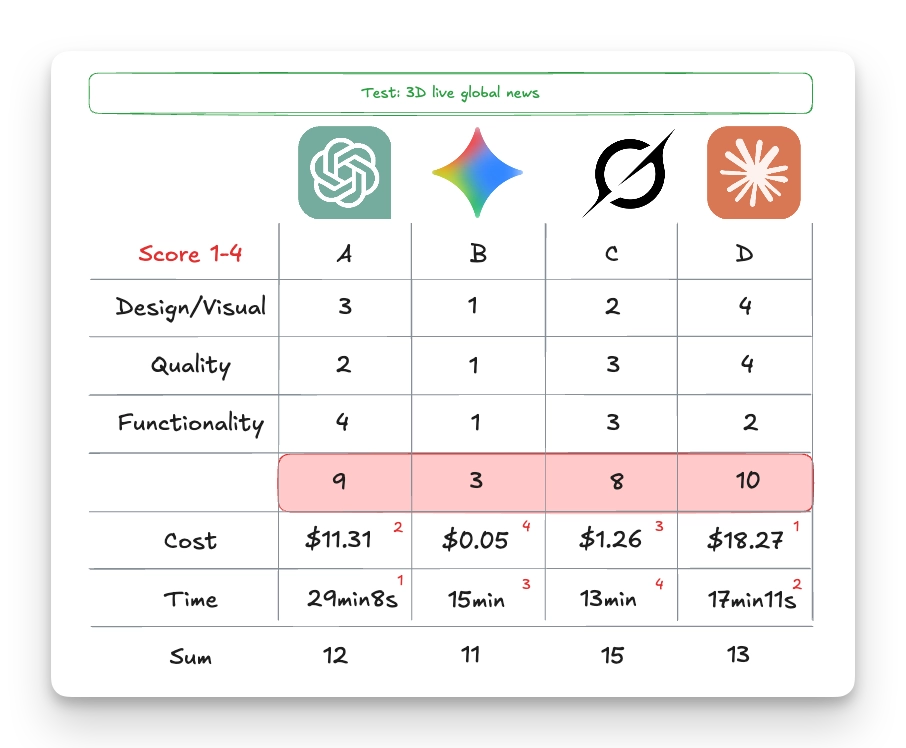
| Claude Fable 5 | Best blind artifact: 10/12 | 17m 11s | $18.27 | Expensive; functionality scored 2/4 |
| GPT-5.6 Sol | Only model with 4/4 functionality | 29m 08s | $11.31 | Slowest; noticeable UI/UX errors |
| Grok 4.5 | Best combined score: 15 points | 13m 00s | $1.26 | Did little beyond the prompt |
| Gemini 3.1 Pro | Cheapest test run | 15m 00s | $0.05 | Minimal result: 3/12 blind score |
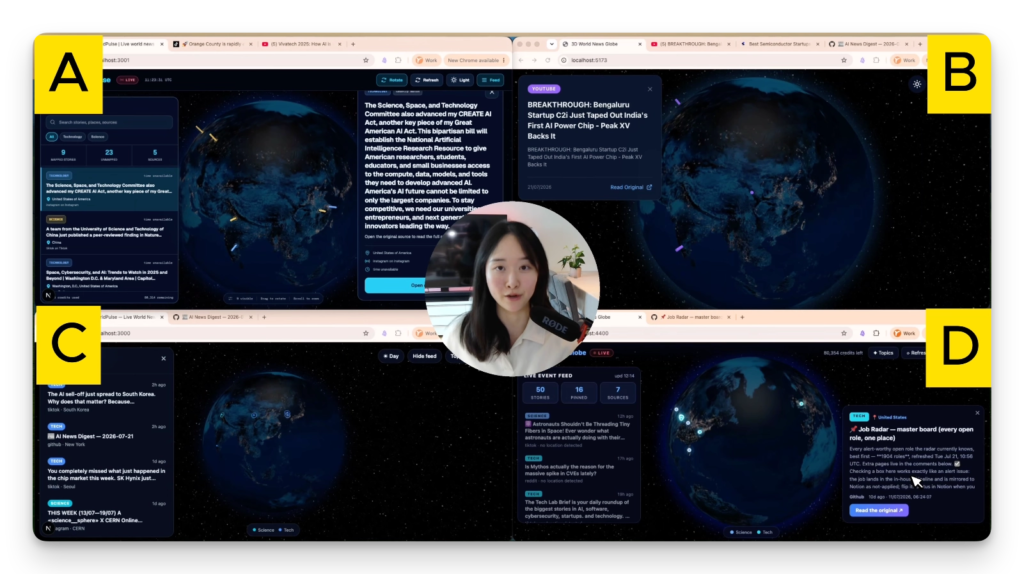
The task was to build a live 3D world-news globe. It had to collect the 50 most recent stories from SocialCrawl, pin them to real locations, rotate, zoom, preview headlines, open summaries, link to sources and support light and dark mode.
The difficult part wasn’t drawing a globe. SocialCrawl returns the sources in text, not latitude and longitude, so each model had to work out how to turn a place mentioned in a story into a real map coordinate.
Find the prompt here 👉 https://ridio-io.notion.site/3d-world-news-map-prompt?source=copy_link
Every model received the same prompt in an empty folder, on the same machine and network. There were no follow-up messages or fixes.
I scored design, quality and completeness, and functionality while the identities were hidden. Only then did I reveal the models, times and dashboard costs.
These official API list prices were checked on July 28, 2026. They differ from the measured run costs because each model used a different number of tokens.
| Model | Context window | Input / 1M tokens | Output / 1M tokens |
|---|---|---|---|
| Claude Fable 5 | 1,000,000 | $10 | $50 |
| GPT-5.6 Sol | 1,050,000 | $5 | $30 |
| Grok 4.5 | 500,000 | $2 | $6 |
| Gemini 3.1 Pro Preview | 1,048,576 | $2* | $12* |
*Gemini’s standard prices rise to $4 input and $18 output when a prompt exceeds 200,000 tokens.
A cheaper token rate doesn’t guarantee a cheaper task. The number of steps and generated tokens matter too.
Fable 5 produced the strongest blind artifact at 10/12, including 4/4 for design and 4/4 for quality. It showed the most judgement around details the prompt didn’t spell out.
The trade-off was efficiency. Fable cost $18.27, the highest amount in the test, while functionality scored only 2/4.
GPT-5.6 Sol was the only model to score 4/4 for functionality. It followed the brief closely and built the most reliable end-to-end workflow.
It was also the slowest at 29 minutes and 8 seconds. Noticeable interface errors meant it still needed a visual clean-up.
Grok 4.5 finished first in 13 minutes and cost $1.26. Solid quality and functionality pushed it to the highest combined result: 15 points.
Its weakness was proactivity. Grok 4.5 was great at following instructions, but it didn’t go beyond that. When requiring proactive decision making, it skipped the process and focused on finishing the task.
Gemini completed the run for $0.05 and finished second-fastest at 15 minutes. But it scored only 1/4 in design, quality and functionality.
That distinction matters. The lowest bill isn’t good value if you have to rebuild most of the result.
There isn’t one winner for every coding task. Your choice depends on whether you’re protecting quality, reliability, time or budget.
| Your priority | Start with | Why |
|---|---|---|
| Ambiguous brief and polished design | Fable 5 | Showed the strongest visual judgement and proactivity |
| Instruction-heavy working build | GPT-5.6 Sol | Scored highest for functionality |
| Fast everyday coding | Grok 4.5 | Best balance in this specific test |
| Lowest-cost rough draft | Gemini 3.1 Pro | Produced the cheapest measured run |
For this type of new build, I’d pick Grok 4.5. It reached a working first version quickly at a sensible cost.
That doesn’t make Grok the universal winner. A legacy codebase or backend-heavy system could produce a different result.
The best AI coding model is the one whose trade-offs match your task. For this test, that meant Grok for balance, Fable for polished output, Sol for functionality and Gemini for the cheapest scaffold.
Overall, it’s not about which AI model is technically the best performing. It’s about which one fits the best in your workflow and gets your job DONE.
Watch the full test here 👉 https://www.youtube.com/watch?v=WNwrmVOGA_o&t=5s
Which model would you have picked before the reveal?
Grok 4.5 might be the first frontier coding model that feels fast enough for everyday work without feeling…
If you've been trying to decide between Claude Code vs Codex, you've probably run into the same wall…
Most people still think about social media data in terms of posts, likes and follower counts. But a…