Physical Address
304 North Cardinal St.
Dorchester Center, MA 02124
Physical Address
304 North Cardinal St.
Dorchester Center, MA 02124

Most people validate business ideas the wrong way. They ask friends, run a Twitter poll, or worse: just start building and hope for the best.
Here’s a better approach: use real Reddit data. Real posts, real complaints, real people describing their frustrations in their own words. Reddit is basically a giant, searchable database of problems people haven’t solved yet.
In this tutorial I’m going to show you exactly how I use Claude Code and SocialCrawl (a social media data API) to go from “I have a business idea” to a structured pain point map with niche-down recommendations in about 10 minutes.
There are four steps. Three of them are for Claude. One of them is you, thinking like a human.
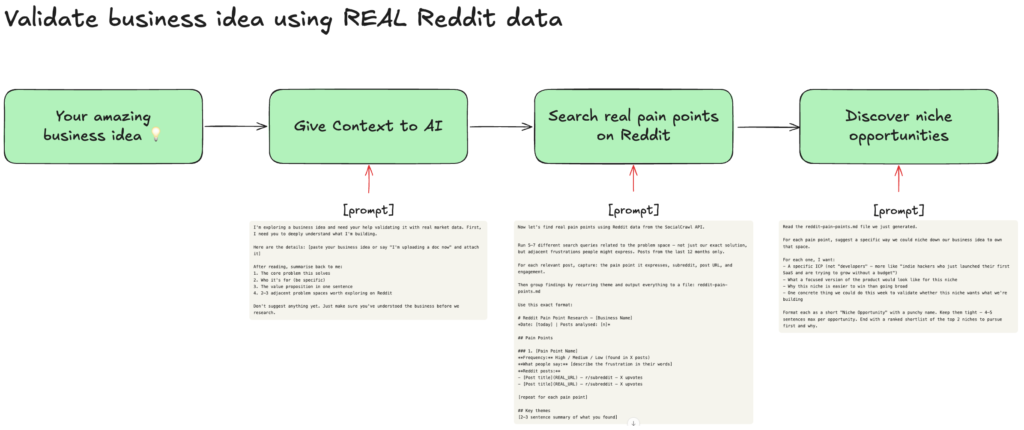
Step 1: Teach Claude your rough business idea
Step 2: Claude searches Reddit via SocialCrawl and maps pain points
Step 3: You read the output and react to it
Step 4: Claude suggests how to niche down around what it found
Let’s go through each one.
Open Claude Code. Before you touch Reddit data, you need Claude to actually understand what you’re building. Not just the surface-level pitch, but the problem space around it. The quality of the Reddit searches it runs later will depend on this.
Paste this prompt, filling in your own details:
I'm exploring a business idea and need your help validating it with real market data. First, I need you to deeply understand what I'm building.

Here are the details: [paste your business idea, or say "I'm uploading a doc now" and attach a file]

After reading, summarise back to me:

The core problem this solves

Who it's for (be specific)

The value proposition in one sentence

2–3 adjacent problem spaces worth exploring on Reddit

Don't suggest anything yet. Just make sure you've understood the business before we research.
Read what it gives back. If it’s missed something important about the problem, correct it before moving on. This step takes two minutes and saves you from getting irrelevant research in step two.
One practical note: if you have a business plan doc, a landing page, or even a detailed note, drag it into Claude Code and reference it in the prompt. The more context it has, the better the Reddit queries it’ll construct.
This is where SocialCrawl comes in. Instead of spending an afternoon manually scrolling Reddit, you’re going to have Claude hit the SocialCrawl API directly, run multiple searches across different angles of the problem, and pull back real posts with real links and real engagement numbers.
The key thing here: you’re not just searching for your exact solution. You want adjacent frustrations. Someone complaining about their Excel workflow, someone asking for a recommendation in a side project subreddit, someone venting about a process that’s broken -> these are all expressing the same underlying pain from different angles.
Paste this prompt:
Now let's find real pain points using Reddit data from the SocialCrawl API.

Use this API to search Reddit:
- Base URL: https://api.socialcrawl.com/v1
- API key header: x-api-key: YOUR_KEY_HERE
- Endpoint: GET /v1/reddit/search

Run 5–7 different search queries related to the problem space — not just
our exact solution, but adjacent frustrations people might express. Posts
from the last 12 months only.

For each relevant post, capture: the pain point it expresses, the subreddit,
the post URL, and the engagement.

Then group findings by recurring theme and output everything to a file:
reddit-pain-points.md

Use this exact format:

# Reddit Pain Point Research — [Business Name]
*Date: [today] | Posts analysed: [n]*

## Pain Points

### 1. [Pain Point Name]
**Frequency:** High / Medium / Low (found in X posts)
**What people say:** [describe the frustration in their words]
**Reddit posts:**
- [Post title](REAL_URL) — r/subreddit — X upvotes
- [Post title](REAL_URL) — r/subreddit — X upvotes

[repeat for each pain point]

## Key themes
[2–3 sentence summary of what you found]
Let it run. While it’s working, you’ll see it constructing the API calls, running searches, filtering results, and grouping findings into themes. It’ll write the markdown file when it’s done.
A few things to look for in the output: the frequency signal matters. A pain point that shows up in one post is noise. A pain point that shows up across five subreddits in different phrasings is a real signal. Also pay attention to the upvote counts on the linked posts 👉 high engagement means the post struck a chord with the community, not just the poster.
If the search comes back thin on a particular query, that’s actually useful data. It either means the problem is niche, or people don’t discuss it in public forums — which tells you something about where you’d need to go to reach them.
This step is on you, and it’s the most important one.
Open reddit-pain-points.md. Read through the pain points. Click the real Reddit links. Reading the actual posts, in context, with the comments, will give you things that a summary never will. You’ll hear the specific language people use. You’ll notice the emotional register: frustrated, resigned, angry, curious. You’ll spot the detail in a top comment that reframes the whole problem.
As you read, look for three things:
What surprised you. The thing you didn’t expect to see is usually the most valuable finding. If you built this idea because you thought people were frustrated about X, and the Reddit data shows they’re actually most vocal about Y. That’s your insight. That’s the market telling you something.
What keeps recurring. If three different subreddits surface the same frustration in different words, pay attention to that. Frequency across communities is a stronger signal than volume within one.
Who’s doing the complaining. The subreddits tell you a lot. A pain point surfacing in r/freelance and r/SaaS simultaneously means two different audiences are feeling it – potentially two different product angles.
Make notes. Have opinions. Then move to step four.
You now have a structured map of real market pain. The final step is turning that into strategic direction 👉 for each pain point, what would a focused version of your business look like if you built specifically for the people experiencing it?
Paste this prompt:
Read the reddit-pain-points.md file we just generated.

For each pain point, suggest a specific way we could niche down our business
idea to own that space.

For each one, I want:
- A specific ICP (not "developers" — more like "indie hackers who just
  launched their first SaaS and are trying to grow without a budget")
- What a focused version of the product would look like for this niche
- Why this niche is easier to win than going broad
- One concrete thing we could do this week to validate whether this niche
  wants what we're building

Format each as a short "Niche Opportunity" with a punchy name. Keep them
tight — 4–5 sentences max per opportunity. End with a ranked shortlist of
the top 2 niches to pursue first and why.
The ranked shortlist at the end is what you’re really after. It’s not just a list of ideas but a prioritised starting point built from actual market evidence, not assumptions.
This exact workflow works for any business idea with a clear problem space. A few tweaks depending on what you’re building:
If your market is technical, add subreddit constraints to the prompt, tell Claude to prioritise r/programming, r/webdev, r/devops, or wherever your people actually hang out. The default search will be broad; a narrower instruction will get you deeper signal.
If your market is consumer rather than B2B, look at the sentiment in the posts more carefully. Consumer pain tends to be expressed emotionally; B2B pain tends to be expressed practically. Both matter, but they suggest different messaging approaches.
If the Reddit data is thin, use the same workflow on other platforms. SocialCrawl covers 22 platforms so swap the endpoint to search LinkedIn posts, TikTok comments, or YouTube discussions depending on where your audience actually spends time.
👉 Claude Design Tutorial: Build A Social Media Dashboard
👉 How to Give Claude Code Social Media data
👉 Claude Code Tutorial for Beginners – Setup Guide
I came across WorldPulse 3D and wanted to build my own 3D world news map with Fable 5.…
If you've ever tried to scrape TikTok data, you've probably hit the same wall. You search for a…
What People Really Think About Claude Opus 4.8 Claude Opus 4.8 dropped on May 28, 2026, and the…