Physical Address
304 North Cardinal St.
Dorchester Center, MA 02124
Physical Address
304 North Cardinal St.
Dorchester Center, MA 02124

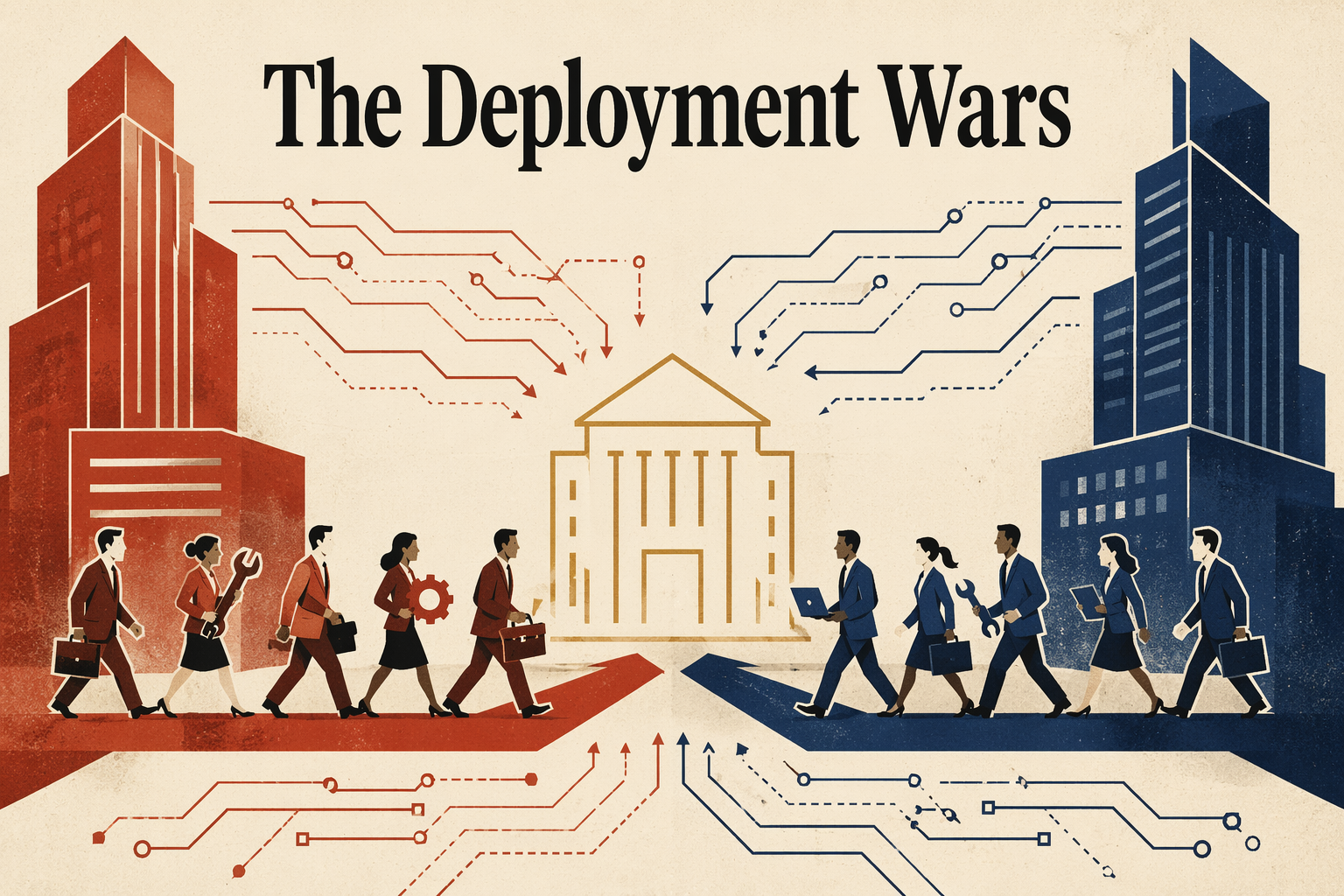
OpenAI and Anthropic stopped competing on benchmarks. This week, they started competing on who can install AI inside your company fastest.
I spent last week watching two of the most valuable private companies in the world do something I never expected. They announced consulting firms.
Not research labs. Not model releases. Consulting firms. The kind of businesses where engineers sit inside your office, redesign your workflows, and bill by the engagement. This is what the AI industry looks like in May 2026. The model race is settled. The deployment race just started.

On May 4, Anthropic and OpenAI both announced enterprise deployment joint ventures within hours of each other. Anthropic partnered with Blackstone, Hellman & Friedman, and Goldman Sachs to form a standalone services firm valued at $1.5 billion. OpenAI went bigger: the OpenAI Deployment Company, backed by $4 billion from TPG, Bain Capital, Brookfield, and 16 other investors, valued at $10 billion.
Both are using the same playbook. Embed engineers inside client organizations. Redesign workflows around AI agents. Charge for implementation, not just API calls.
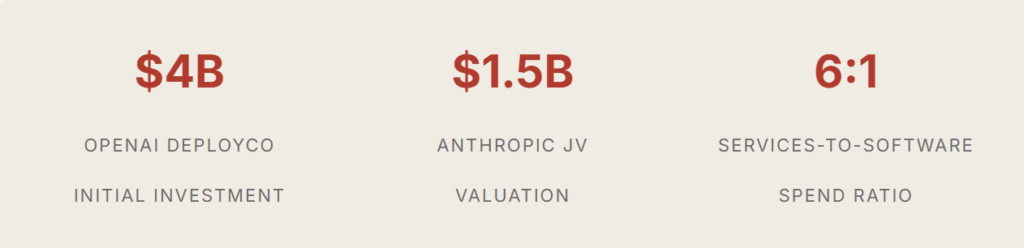
OpenAI acquired Tomoro to get 150 forward-deployed engineers on day one, with a client list that includes Mattel, Red Bull, and Tesco. Anthropic’s CFO Krishna Rao put it bluntly: “Enterprise demand for Claude is significantly outpacing any single delivery model.”
Here is the number that explains everything. For every dollar companies spend on software, they spend six on services. That ratio built McKinsey and Accenture into trillion-dollar forces. OpenAI and Anthropic are now going after that same pool. Both are reportedly targeting IPOs in fall 2026, and public markets want to see enterprise revenue, not research papers.
“When I was doing AI transformation consulting, the hardest problem was never the technology. It was getting organizations to actually change how they work.”
The fact that both companies are building entire ventures around that problem tells you where the real bottleneck sits.

Google I/O 2026 on May 19 was not about models. It was about agents.
The headline release was Gemini 3.5 Flash, which outperforms the much larger Gemini 3.1 Pro on coding and agentic benchmarks. It scores 76.2% on Terminal-Bench 2.1 and 83.6% on MCP Atlas. But the model was secondary to what Google built on top of it.
Antigravity 2.0 is Google’s agent-first coding platform (their answer to Cursor and Claude Code), rebuilt around subagents, hooks, and asynchronous task management. Gemini 3.5 Flash runs 12x faster inside Antigravity than its predecessor.
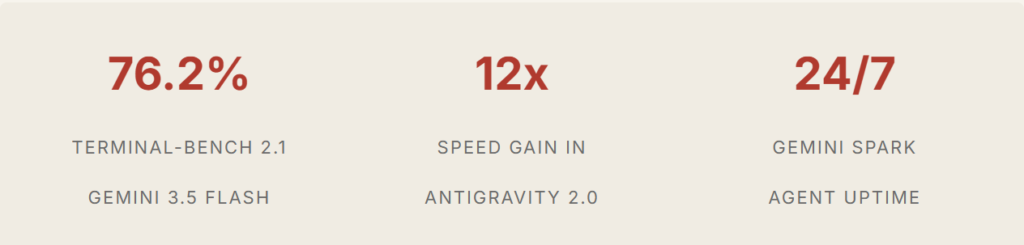
The most interesting announcement was Gemini Spark: a personal AI agent that runs on Google Cloud VMs around the clock, working on long-running tasks even when your laptop is closed. You can email it. It checks back when the work is done.
Google also brought agents into Search. Information agents now monitor apartment listings, track sneaker drops, and notify you when conditions match. The search box is becoming an always-on assistant. And with Android Halo, a new system-level agent activity monitor, Google is building the notification layer for agents across all of Android.
Models are infrastructure. Agents are the product.

On May 7, the EU Council and Parliament reached agreement on the AI Act Omnibus after a nine-hour overnight trilogue session. The most immediate impact: any generative AI system shipped into the EU must implement machine-readable watermarking by December 2, 2026.
That means UI labeling, metadata embedding, and detection capability. All operational in about six months. Industry groups had lobbied for a 12-month grace period. They got four months.
The agreement also bans nudifier applications (AI tools that generate non-consensual intimate imagery) effective the same date, and pushes high-risk AI compliance deadlines to December 2027 for standalone systems and August 2028 for regulated products.
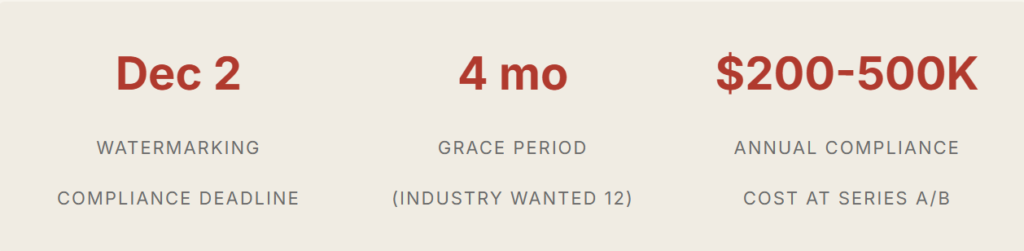
For startups, the compliance math is real. At seed stage, founders are looking at 15 to 20 percent higher legal expenses before generating any revenue. At Series A and B, annual compliance costs run $200K to $500K. If you are building anything generative and selling into Europe, watermarking infrastructure is no longer a nice-to-have. It is a line item in your next fundraise.

Cursor is in talks to raise at least $2 billion at a roughly $50 billion valuation, led by Thrive and Andreessen Horowitz. The company hit $2 billion in annualized revenue by February 2026, making it the fastest B2B software company to reach that milestone on record. Faster than Slack. Faster than Zoom. Faster than Snowflake.
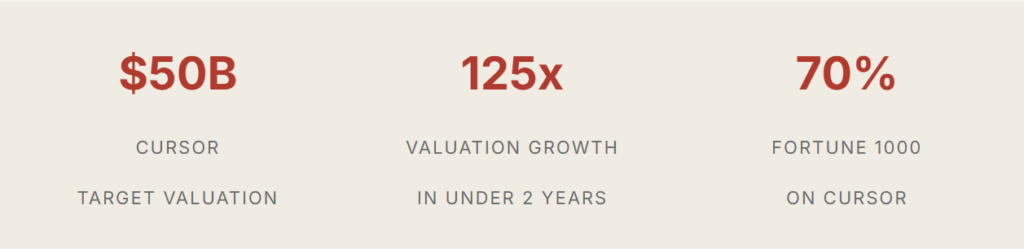
Nearly 70% of the Fortune 1000 uses Cursor. More than half of all code on GitHub is now AI-generated or AI-assisted. Cursor forecasts ending 2026 above $6 billion in annualized revenue. For context, the company’s Series A closed in August 2024 at a $400 million valuation. Less than two years later, it is worth 125 times that. Four MIT co-founders built the defining company of the AI coding wave, and they did it not by training their own models, but by making someone else’s models useful.
Meanwhile, Visa unveiled Intelligent Commerce Connect, a platform that lets AI agents make payments across multiple card networks. Not just Visa’s own network. Merchants can make product catalogs discoverable directly to agents, bypassing traditional checkout flows. Visa is working with over 100 partners, with more than 30 already building in its agent commerce sandbox. The company predicts millions of consumers will use AI agents for purchases by the 2026 holiday season.
The companies capturing the most value in AI are not the ones building foundation models. They are the ones building the layer where AI touches work and money.
Cursor sits between the model and the developer. Visa sits between the agent and the transaction. That is where the margin lives.
This is the week AI stopped being a research competition and became an implementation competition. The question is no longer who has the best model. It is who can get AI running inside your organization, your workflow, your checkout, your codebase before everyone else does.
If you are building right now, the signal is clear. Ship the integration, not the benchmark.
This week, the AI industry moved beyond ambitious claims. OpenAI published machine-checkable proofs, model prices fell, autonomous agents…
Three teams released models above 900 billion parameters in a single week. The interesting question is not the…
GPT-5.6 solves a 50-year math problem. An AI agent raises $100 million. And Congress wants to know who…