Physical Address
304 North Cardinal St.
Dorchester Center, MA 02124
Physical Address
304 North Cardinal St.
Dorchester Center, MA 02124
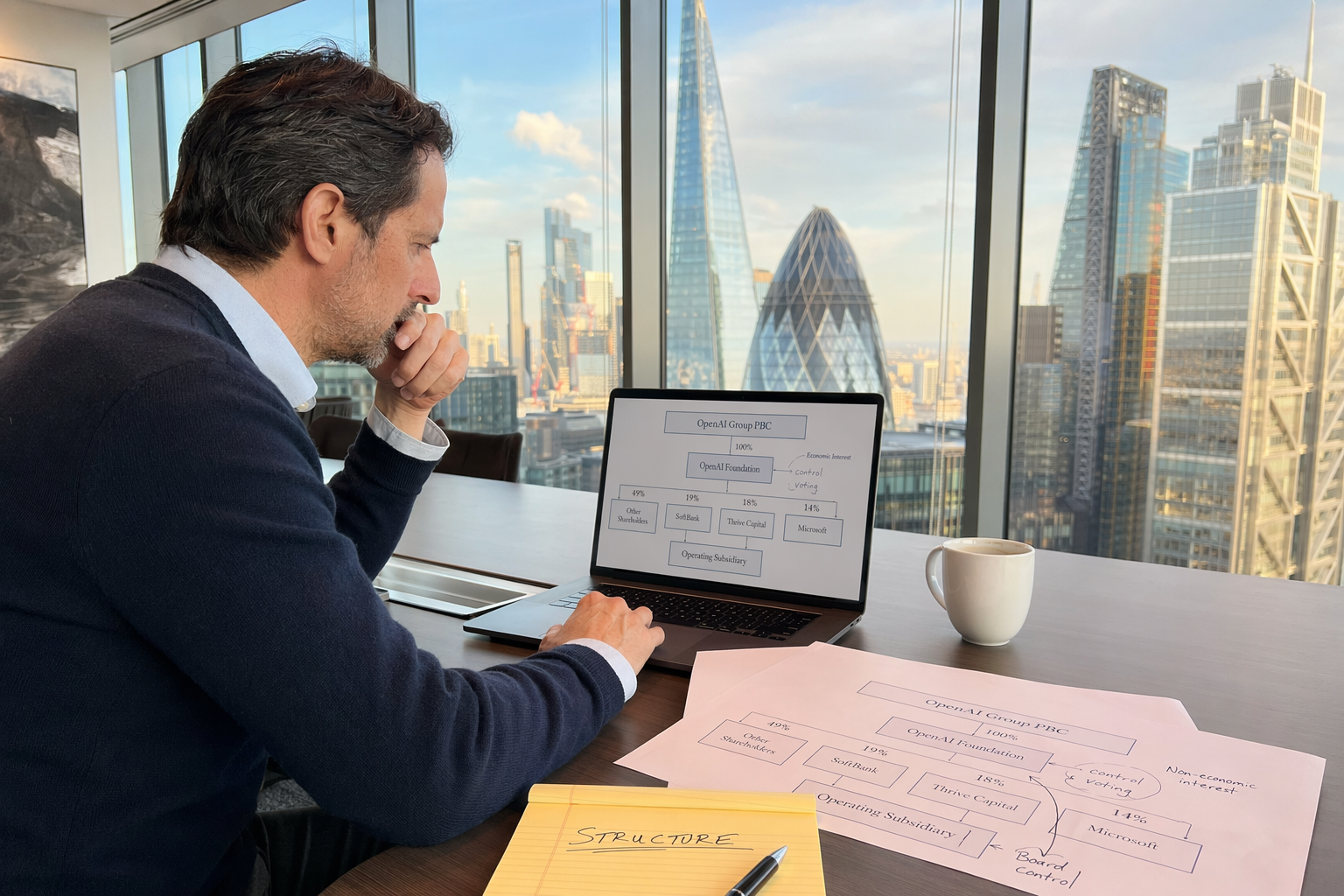
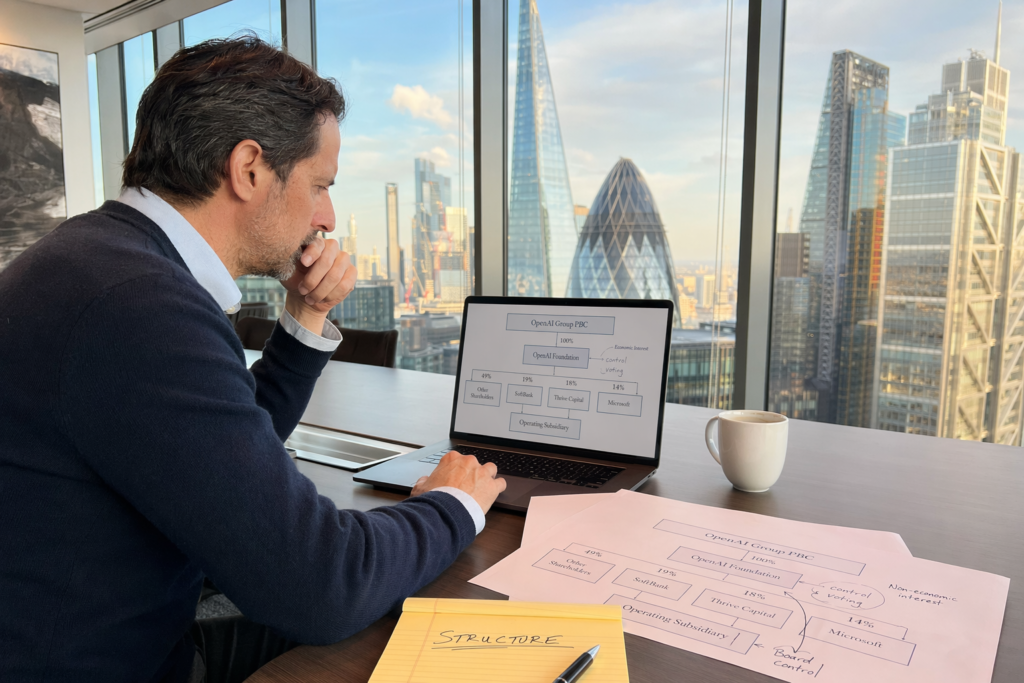
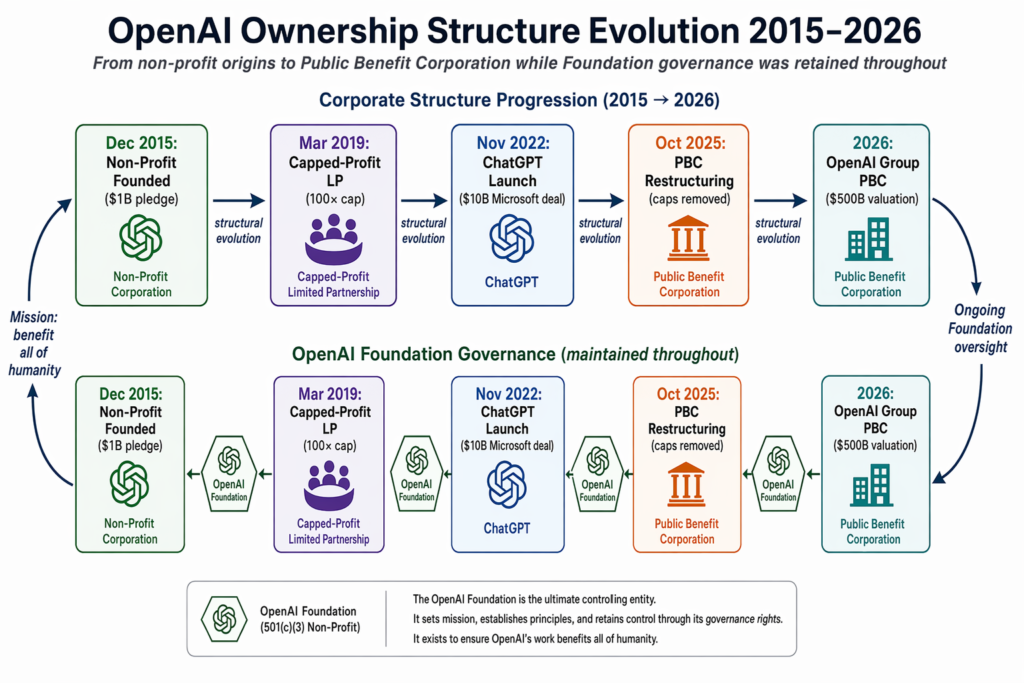
ChatGPT is owned by OpenAI Group PBC, a Delaware Public Benefit Corporation controlled by the OpenAI Foundation, a non-profit that holds the sole power to appoint and replace the board. Microsoft is the largest single investor with roughly a 27% economic stake, but it does not own ChatGPT and has no controlling interest. The structure was reshaped in October 2025, when OpenAI removed the 100x profit cap and converted its commercial arm into a PBC now valued at around $500 billion.
The rest of this article explains what sits behind that answer and what it means for UK businesses relying on ChatGPT today.
The legal owner of ChatGPT is OpenAI Group PBC, the Delaware Public Benefit Corporation created during the October 2025 restructuring. According to OpenAI’s “Evolving our structure” announcement, the PBC holds the commercial assets, employs the staff, signs the Microsoft cloud contracts and operates chatgpt.com. The OpenAI Foundation, the renamed non-profit parent, sits above the PBC, holds approximately 26% of its equity and appoints every director on the PBC board.
The word “ownership” actually bundles three distinct questions. Who runs ChatGPT day to day? OpenAI’s executive team, led by chief executive Sam Altman and president Greg Brockman. Who profits from it? The shareholders of OpenAI Group PBC, in proportion to their stakes. Who can change its direction or remove its leadership? The OpenAI Foundation, through its board-appointment rights.
ChatGPT itself is a product, not a company. The trademark, the model weights, the training data licences and the API revenue all sit inside OpenAI Group PBC. If you signed up for ChatGPT Plus this morning, your £20 a month flows to that entity.
No. Microsoft does not own ChatGPT, despite investing more than $13 billion since 2019. It holds roughly a 27% economic interest in OpenAI Group PBC — the single largest corporate stake — but carries no controlling rights and no board seat. According to Microsoft’s October 2025 partnership update, the relationship is a long-term commercial agreement: Azure is the exclusive cloud provider for OpenAI’s frontier training, and Microsoft has rights to integrate OpenAI models into Copilot, Bing, Office 365 and Windows.
The confusion is understandable. Satya Nadella has appeared on stage with Sam Altman more than any other external executive. Microsoft’s Copilot products run on GPT models, and Azure data centres in Quincy, Washington and Mona, Wales handle a meaningful share of ChatGPT’s inference load. But ownership and partnership are not the same thing. Microsoft cannot fire Altman, block a model release, or redirect OpenAI’s research roadmap. When the November 2023 board crisis temporarily removed Altman, Microsoft was reduced to publicly lobbying for his return rather than acting through a shareholder vote.
For UK readers, this matters because Microsoft UK, headquartered in Reading, is the legal counterparty for most British Copilot deployments, with data processing routed through Microsoft Ireland Operations Limited. A ChatGPT Enterprise contract, by contrast, sits with OpenAI OpCo, LLC, a subsidiary of the PBC.
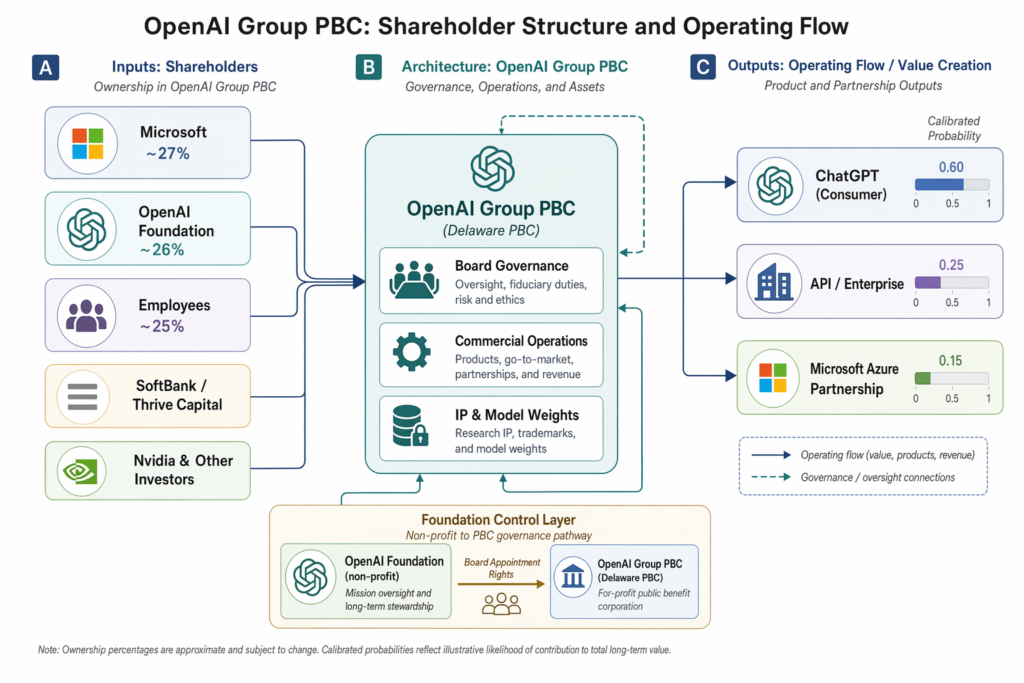
The October 2025 restructuring was the most significant change to OpenAI’s corporate form since its founding. Three things happened at once. The for-profit subsidiary, previously called OpenAI LP and then OpenAI Global LLC under a capped-profit model, was converted into OpenAI Group PBC. The 100x profit cap on investor returns — and the specific 20x cap on Microsoft’s returns — were removed. And the original non-profit was renamed the OpenAI Foundation and given a defined 26% equity stake alongside its existing governance rights.
Removing the cap means investor upside is now uncapped. That’s the primary reason SoftBank was willing to lead a $40 billion funding round in April 2025 at a $300 billion valuation, according to a SoftBank Group press release. By October 2025, secondary share sales valued the company at approximately $500 billion, making it the largest privately held company in the world.
The PBC form is a recognised Delaware structure, used by Patagonia, Allbirds and Kickstarter, and requires directors to balance shareholder returns against a stated public benefit purpose. OpenAI’s stated purpose, embedded in the PBC charter, is “to ensure that artificial general intelligence benefits all of humanity”.
Elon Musk owns no stake in ChatGPT and has no governance role at OpenAI, despite being one of the original co-founders in December 2015. Musk contributed around $45 million of the initial billion-dollar pledge, sat on the board for roughly two years, and resigned in February 2018, citing a conflict with Tesla’s growing AI programme. In early 2024 he filed a lawsuit against OpenAI, Altman and Brockman in California, alleging breach of contract and seeking damages reported by AP News at up to $150 billion.
The Musk litigation is the most consequential live legal challenge to OpenAI’s current structure. Musk argues that the for-profit conversion betrayed the founding non-profit mission. OpenAI counters — with internal emails it has published — that Musk himself proposed merging OpenAI into Tesla and pushed for a more aggressive commercial path before leaving. As of May 2026, the case is heading toward a jury trial in San Francisco. The outcome could in theory force changes to the PBC structure, though most securities lawyers quoted in the Wall Street Journal view a structural reversal as unlikely.
Musk’s own venture xAI launched the Grok assistant in November 2023 and now competes directly. In legal terms, his relationship with ChatGPT is that of a plaintiff, not an owner.
The OpenAI Foundation board of directors, as of October 2025, comprises Bret Taylor as independent chair, alongside Adam D’Angelo, Dr Sue Desmond-Hellmann, Dr Zico Kolter, General Paul M. Nakasone (Ret.), Adebayo Ogunlesi, Nicole Seligman and Sam Altman as chief executive. This board controls both the Foundation and, through its appointment power, the OpenAI Group PBC board. According to OpenAI’s “Our Structure” page, board members serve fixed terms and can be replaced only by other Foundation directors, creating a deliberately self-perpetuating governance model.
Two members stand out for UK readers. Adebayo Ogunlesi — the Nigerian-British founder of Global Infrastructure Partners and now a senior figure at BlackRock — brings infrastructure and capital markets experience relevant to OpenAI’s $500 billion Stargate programme. Nicole Seligman, former general counsel of Sony Corporation, brings the crisis-management experience that proved critical during the November 2023 board upheaval that briefly removed Altman.
Notably absent from the board: Microsoft, SoftBank, Thrive Capital and any other shareholder. Equity investors in the PBC receive financial returns but no governance seat. That is the single biggest reason regulators in the United States, the European Union and the UK Competition and Markets Authority have repeatedly concluded that Microsoft does not exercise “decisive influence” over OpenAI within the meaning of merger control law.
ChatGPT is the largest consumer AI product in the world by active users. According to DemandSage, it had approximately 810 million monthly active users in November 2025, with 800 million weekly active users reported by Backlinko in September 2025. The product launched on 30 November 2022 and reached one million users in five days — the fastest consumer adoption ever recorded at the time.
The revenue trajectory is steeper still. OpenAI generated $3.7 billion in revenue in 2024 and reached $10 billion annual recurring revenue by June 2025, with annualised 2025 revenue now tracking at $20 billion. ChatGPT Plus, the £20-a-month consumer subscription, had roughly 10 million paying subscribers by late 2024, generating around $200 million per month. Mobile app revenue alone grew 673% year on year to $1.35 billion in 2025, per Backlinko. GPT-4o, the multimodal default model released in May 2024 and described by IBM as the company’s “omni” flagship, is the principal driver of paid conversion.
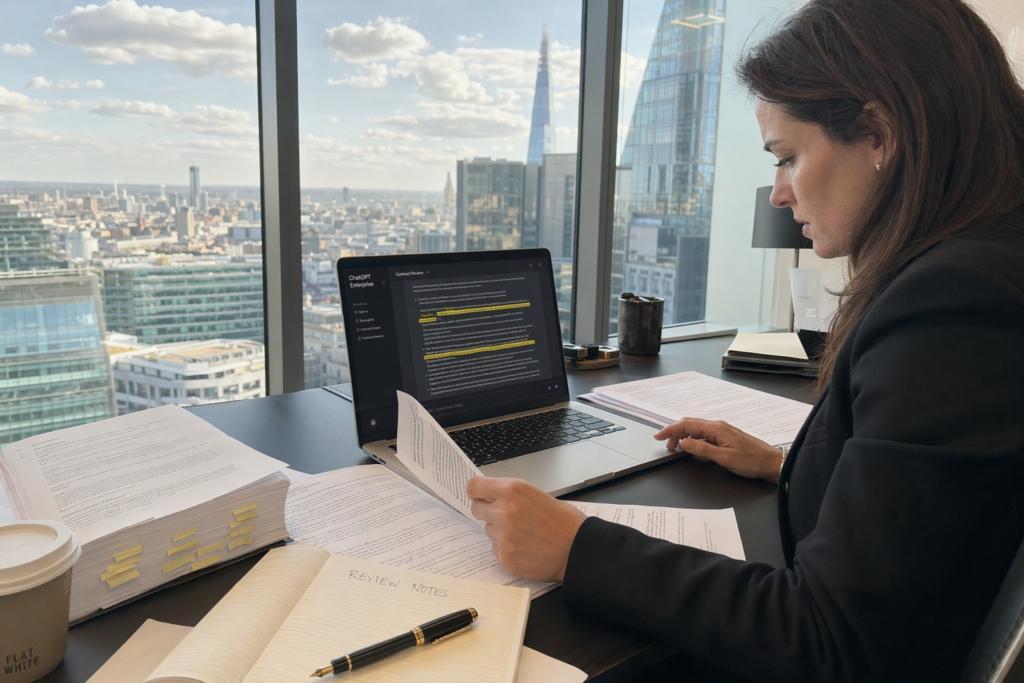
For UK businesses, the relevant figure is enterprise adoption. According to industry tracking summarised by Master of Code, over 80% of Fortune 500 companies had integrated ChatGPT into their workflows within nine months of launch. ChatGPT Enterprise, launched in August 2023 with no-training privacy guarantees, now serves clients including Morgan Stanley, PwC and Klarna. Klarna publicly reported that its OpenAI-powered support agent handles 2.3 million conversations a month — equivalent to roughly 700 full-time human agents.
For UK users, ownership determines which legal regime governs your data and which regulator handles complaints. ChatGPT Enterprise and Team contracts for UK customers are signed with OpenAI Ireland Limited, bringing the service under UK GDPR and EU GDPR, with the Information Commissioner’s Office acting as the lead supervisory authority for consumer complaints. The Competition and Markets Authority reviewed the Microsoft-OpenAI relationship across 2024 and 2025 and concluded in March 2025 that it did not constitute a relevant merger situation. The October 2025 restructuring has so far not reopened that finding.
For UK businesses, there are three practical implications worth knowing. Procurement teams should know that signing a ChatGPT contract means contracting with OpenAI directly, not Microsoft, even if your Azure agreement runs alongside it. Compliance teams should note that OpenAI publishes a UK-specific Data Processing Addendum and now offers EU data residency for Enterprise customers, with UK residency added in late 2025. Boards should flag that the Foundation governance structure means OpenAI’s strategic direction can shift in ways a normal shareholder vote could not predict — a genuine concentration risk to include in third-party risk registers.
UK-specific deployments include NHS pilots using Microsoft Azure OpenAI Service for clinical note summarisation, Allen & Overy’s Harvey legal assistant built on GPT-4, and the Cabinet Office AI Incubator, which uses GPT-4o for internal policy drafting under a contract negotiated by the Central Digital and Data Office.
You cannot buy shares in ChatGPT or OpenAI on any public stock exchange as of May 2026. OpenAI Group PBC remains privately held with no announced initial public offering. Retail investors in the UK have no direct way to own a slice. The Wikipedia entry on OpenAI confirms the company remains private despite a $500 billion valuation, and OpenAI’s own statements have consistently declined to commit to an IPO timeline.
Three indirect routes exist. Buying Microsoft shares gives you exposure to a 27% economic interest in OpenAI Group PBC plus the Copilot and Azure businesses. SoftBank Group shares on the Tokyo Stock Exchange now carry meaningful OpenAI exposure following the April 2025 funding round. Accredited investors can participate in secondary offerings through platforms such as Forge Global or EquityZen, typically with tickets above $100,000. Current and former OpenAI employees hold roughly 25% of the PBC, and an October 2025 tender offer allowed them to realise $6.6 billion in liquidity.
UK retail investors should note that Scottish Mortgage Investment Trust, managed by Baillie Gifford and listed on the London Stock Exchange under SMT.L, holds a direct OpenAI stake acquired in earlier funding rounds. It remains one of the few mainstream UK-accessible routes to OpenAI exposure without accredited investor status.
ChatGPT is owned by OpenAI, specifically by OpenAI Group PBC, the Delaware Public Benefit Corporation created in October 2025. Microsoft is the largest external investor with approximately a 27% economic stake but holds no board seat, no veto rights and no operational control. Microsoft’s role is as exclusive cloud provider and commercial partner, not as owner.
Sam Altman is the chief executive of OpenAI and a member of the OpenAI Foundation board, but he holds no significant equity stake in OpenAI Group PBC. Altman has stated publicly, including in US Senate testimony in 2023, that he does not own OpenAI shares beyond minimal indirect exposure through the Y Combinator fund that invested in 2016. His influence comes from his executive role and his board seat, not from ownership.
OpenAI has a hybrid structure. The OpenAI Foundation is a non-profit and retains governance control through its sole power to appoint and replace the board. OpenAI Group PBC, which owns and operates ChatGPT, is a for-profit Public Benefit Corporation. So the company is governed by a non-profit but operated as a for-profit, with the two linked by the Foundation’s 26% equity stake and board-appointment rights.
OpenAI was founded in December 2015 by a group that included Sam Altman, Elon Musk, Greg Brockman, Ilya Sutskever, Wojciech Zaremba and John Schulman, with $1 billion in committed funding. ChatGPT itself was built by OpenAI’s research and product teams and launched on 30 November 2022. The conversational interface was led by a team including Brockman, Sutskever and product chief Peter Deng, with Mira Murati serving as chief technology officer at the time of launch.
No UK company, or any other company, can buy OpenAI in a normal acquisition sense, because the OpenAI Foundation controls the board and its non-profit charter explicitly prevents a sale that would transfer control to a single private buyer. A hostile takeover is structurally impossible. The closest a UK firm could come is acquiring shares in the secondary market or partnering through the Azure OpenAI Service, which is available to UK enterprises through Microsoft’s UK South and UK West Azure regions.
This week, the AI industry moved beyond ambitious claims. OpenAI published machine-checkable proofs, model prices fell, autonomous agents…
Three teams released models above 900 billion parameters in a single week. The interesting question is not the…
GPT-5.6 solves a 50-year math problem. An AI agent raises $100 million. And Congress wants to know who…