Physical Address
304 North Cardinal St.
Dorchester Center, MA 02124
Physical Address
304 North Cardinal St.
Dorchester Center, MA 02124

June 1, 2026 · 5 min read

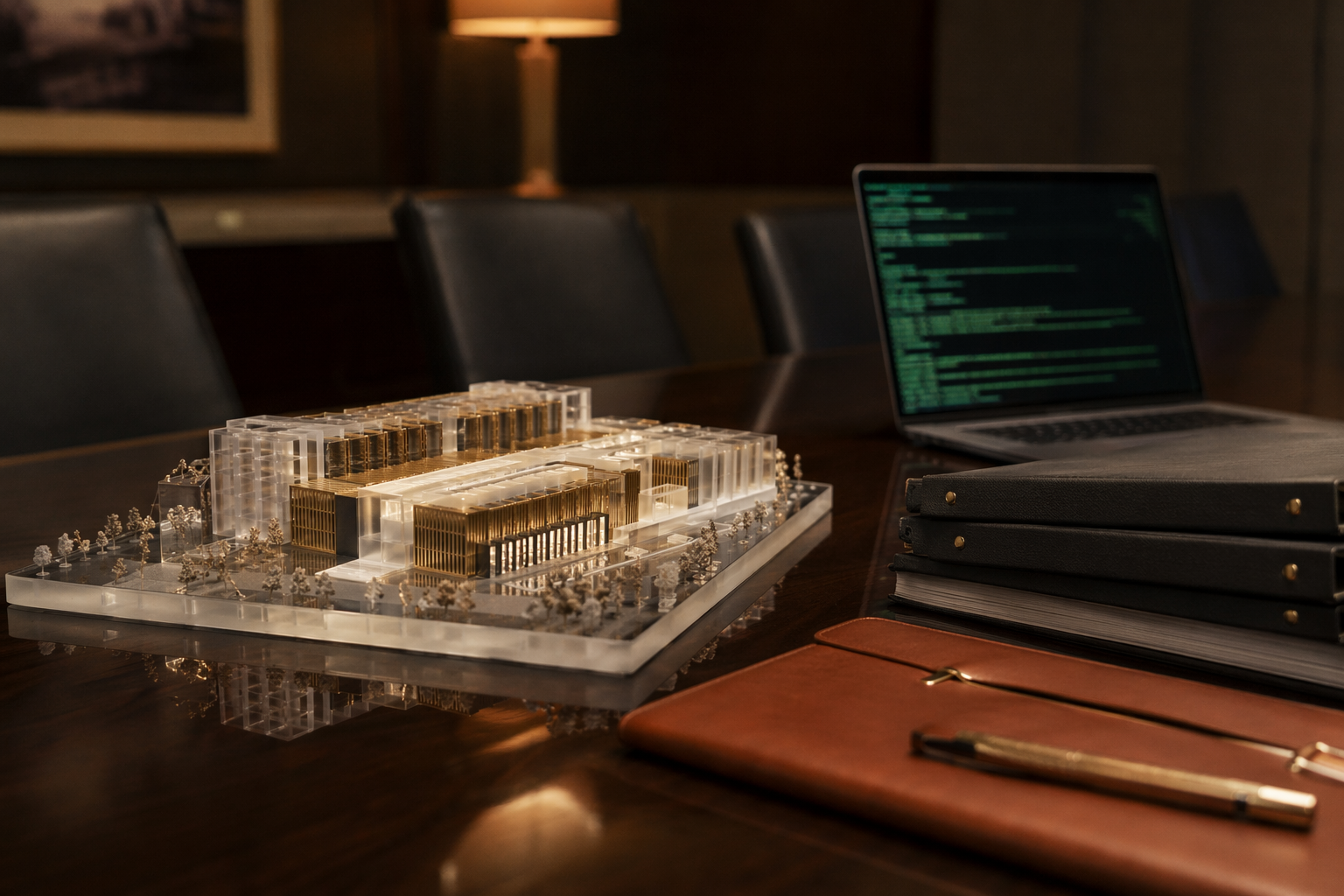
Figure 01 — The war moved from the lab to the boardroom. AI labs are no longer just shipping models.
Iused to be an AI transformation consultant. I spent years inside enterprises helping them figure out where AI fits, what to build first, and how to actually get it into production. So when I saw that OpenAI just bought a consulting firm and launched a $4 billion deployment company, I felt something I did not expect. Recognition.
The AI industry just told the world what operators have known for a while: building a great model is not enough. You have to put it to work.

Figure 02 — Forward Deployed Engineers: OpenAI’s new plan to embed AI specialists inside client organizations.
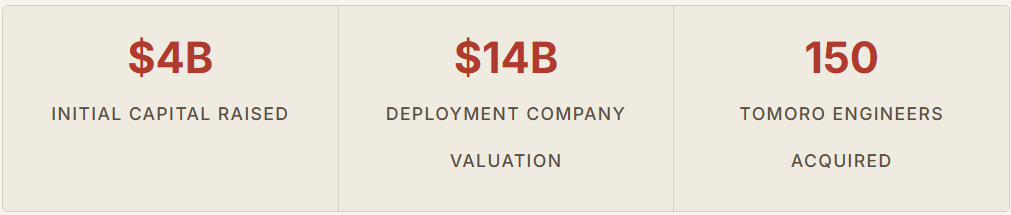
On May 12, OpenAI launched the OpenAI Deployment Company, a majority-owned subsidiary backed by $4 billion in initial capital from a syndicate led by TPG, with Advent International, Bain Capital, and Brookfield as co-leads. The entity launched at a $14 billion valuation with a mandate to embed “Forward Deployed Engineers” directly inside client organizations to build and operate production AI systems.
The first move was acquiring Tomoro, a London-based AI consultancy with about 150 engineers. Tomoro built AI concierges for Virgin Atlantic, in-game support agents for Supercell, and deployment systems for Fidelity International, Tesco, and the NBA. These are real implementations, not demos.
Here is the part that caught my eye. On the day of the announcement, shares in major IT services firms fell 3% to 5%. Wall Street priced it immediately: OpenAI is no longer just competing with Anthropic and Google on models. It is recruiting from the same talent pool, pitching the same CIOs, and billing against the same budget lines as Deloitte and Infosys.
Anthropic made a parallel move. Its $1.5 billion joint venture with Blackstone, Goldman Sachs, and Apollo will embed Anthropic engineers inside midsized businesses. The message from both labs is identical: the deployment gap is real, and whoever closes it fastest wins the enterprise.
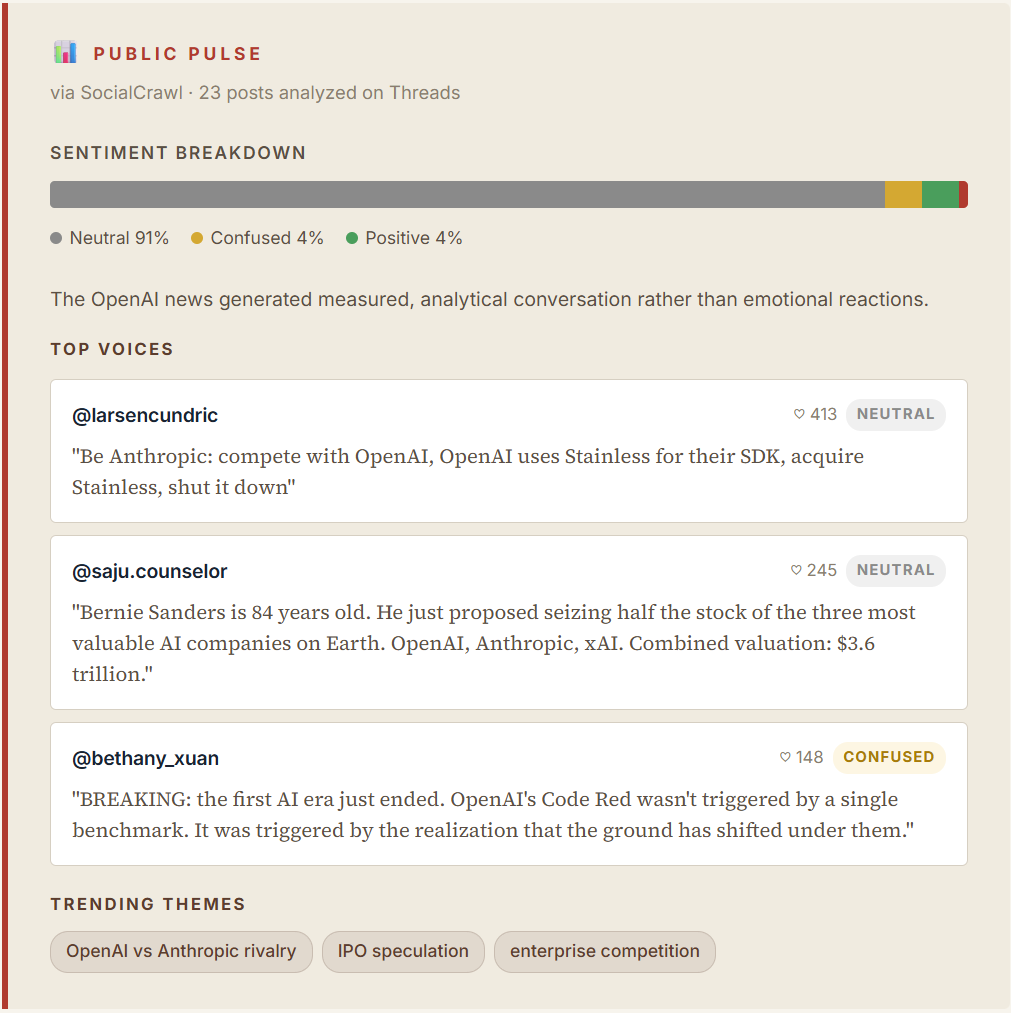

Figure 03 — Project Glasswing: AI found the vulnerabilities. Humans cannot patch them fast enough.
Anthropic had a stacked month. On May 28, it released Claude Opus 4.8, just 41 days after shipping Opus 4.7. That cadence matters. The model scored 69.2% on SWE-Bench Pro (up from 64.3%), introduced “Dynamic Workflows” that let Claude plan work and run hundreds of parallel subagents in a single session, and launched a fast mode at 2.5x speed for three times less than before.
“The AI is faster at breaking things than humans are at fixing them.”
But the more consequential Anthropic story is Project Glasswing. Through its Claude Mythos Preview, a model too dangerous to release publicly, Anthropic and about 50 partner organizations have now found more than 10,000 high- or critical-severity vulnerabilities across the world’s most important software. Mythos autonomously discovered and exploited a 17-year-old remote code execution vulnerability in FreeBSD (CVE-2026-4747) that gives root access to any machine running NFS. No human was involved after the initial request.
The bottleneck has inverted. Finding vulnerabilities used to be the hard part. Now, patching them is. Only 75 of 530 disclosed high- or critical-severity bugs have been fixed so far. Some open-source maintainers have asked Anthropic to slow the pace of disclosures because a typical high-severity fix takes about two weeks. This is a strange new world: the AI is faster at breaking things than humans are at fixing them.
Anthropic committed $100 million in model usage credits to Glasswing and has no plans to release Mythos publicly until safeguards catch up.
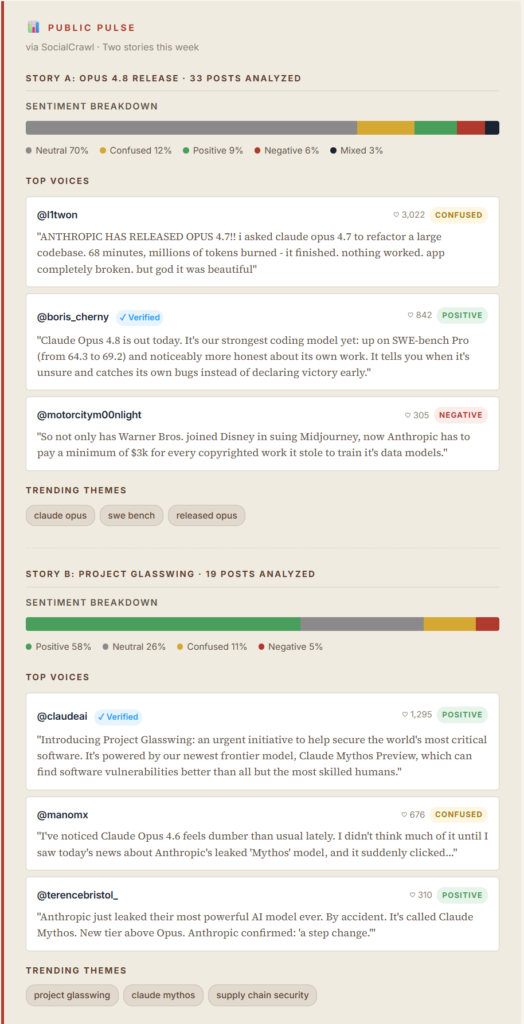

Figure 04 — Flash-first: Google is betting that speed and cost matter more than raw benchmark scores.
Google I/O 2026 came with the usual flood of announcements. But the strategic signal was in one move: Gemini 3.5 Flash was the headline model, not a “Pro” or “Ultra” variant.
Gemini 3.5 Flash surpasses 3.1 Pro in coding, agentic, and multimodal benchmarks while running at 4x the output speed of other frontier models. Google also announced Gemini Omni, a new series that accepts image, audio, video, and text input and outputs video grounded in real-world knowledge.
The pricing tells the story. Google restructured its AI subscriptions around compute-based usage limits that refresh every five hours, dropped its AI Ultra plan from $250 to $200 per month, and positioned Flash as the primary interface for the agent era. Every model in the May cohort launched with a time-limited discount that will increase 2x to 3x within 90 days.
Google is saying: the best model is not necessarily the biggest one. It is the fastest one that clears the quality bar. For founders building on LLM APIs, this is the right instinct. Cost per token and latency per call matter more than benchmark bragging rights once you are in production.

Figure 05 — Meta’s 2026 capex could reach $145 billion. The physical scale of AI is becoming impossible to ignore.
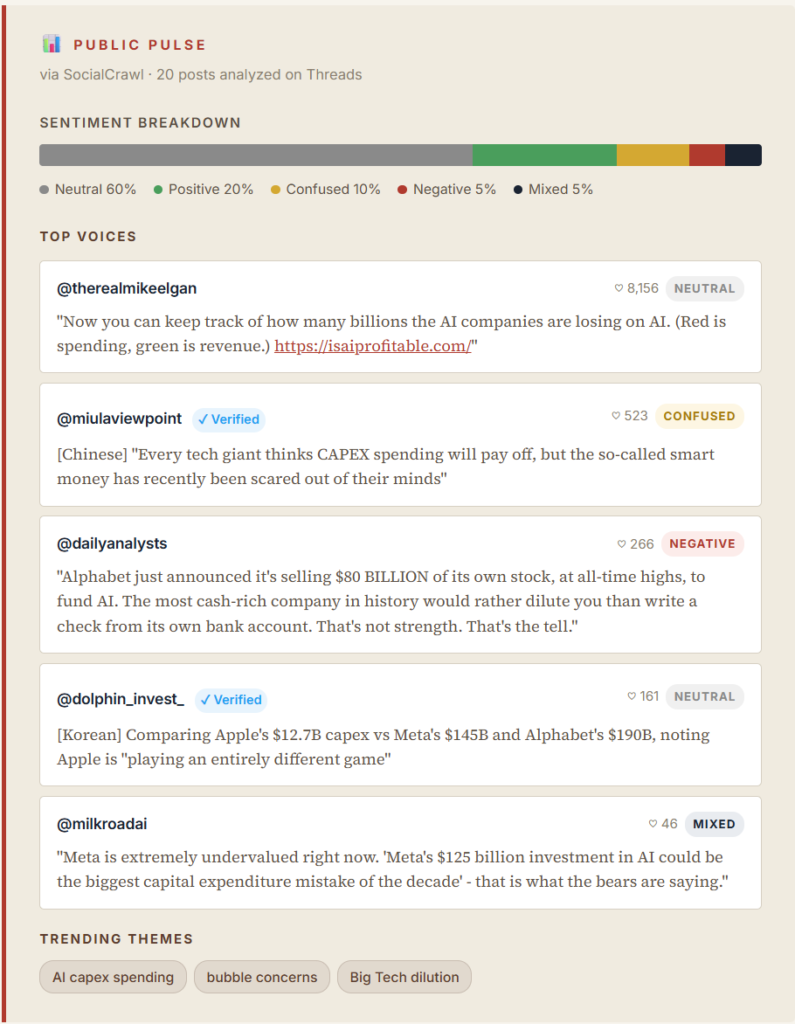
Meta raised its 2026 capital expenditure guidance to $125 billion to $145 billion, up from an already staggering $115 billion to $135 billion. That is nearly double what it spent in 2025. When asked about signs of ROI at the earnings call, Mark Zuckerberg replied: “that’s a very technical question.” The stock dropped 6% after hours.
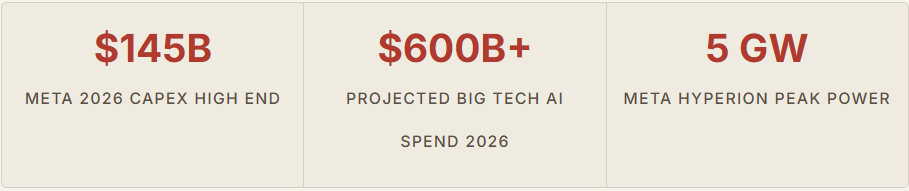
Big Tech is now projected to spend over $600 billion on cumulative AI capital expenditures in 2026. Meta’s “Hyperion” data center campus in Louisiana alone could use 5 GW of electricity, roughly the amount consumed by 4.2 million homes. CoreWeave signed a $21 billion deal with Meta for AI cloud capacity through 2032.
These are not experimental budgets. This is industrial-scale infrastructure being built on the assumption that AI demand will grow for years. If that assumption is wrong, these companies are sitting on the most expensive real estate in history. If it is right, they will have moats that startups cannot replicate.
Meanwhile, the EU pushed out its AI Act compliance deadlines by 16 months for high-risk systems and carved out industrial AI entirely. Even regulators seem to be admitting that the industry is moving faster than the rules can keep up.
The Bottom Line
The deployment war has begun
The question has changed. A year ago, the conversation was about which model is smartest. Now it is about who can deploy fastest, at the lowest cost, with the fewest things broken. OpenAI is buying consulting firms. Anthropic is embedding engineers in banks. Google is betting on speed over size. Meta is spending more on data centers than most countries spend on defense.
For founders, the implication is direct. The window for building on top of these models is wide open, but it will not stay that way. The labs are coming downstream. They want the integration layer, the deployment revenue, the recurring enterprise contracts. If your company sits between a model API and a customer, you need a defensible reason to exist that is not just “we are easier to use.”
The model war got a sequel this month. It is called deployment. And the consulting firms, system integrators, and startups in the middle should be paying very close attention.
Weekly Briefing The Big Four bet 750,000 seats on Claude. A Fields Medalist says GPT did PhD-level math…
The best AI search engines aren't trying to replace Google. They're each better at one specific job: explanations,…
Learn how consultants use Gen AI tools for market research with a structured method that produces more reliable…