Physical Address
304 North Cardinal St.
Dorchester Center, MA 02124
Physical Address
304 North Cardinal St.
Dorchester Center, MA 02124
The Big Four bet 750,000 seats on Claude. A Fields Medalist says GPT did PhD-level math in two hours. Google breaks cloud lock-in with a $5B TPU venture. And five governments draw the line on agents.
By Woosub Kim · May 28, 2026 · 5 min read

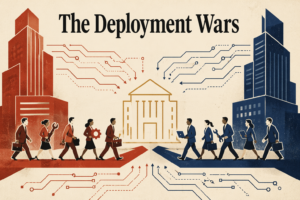
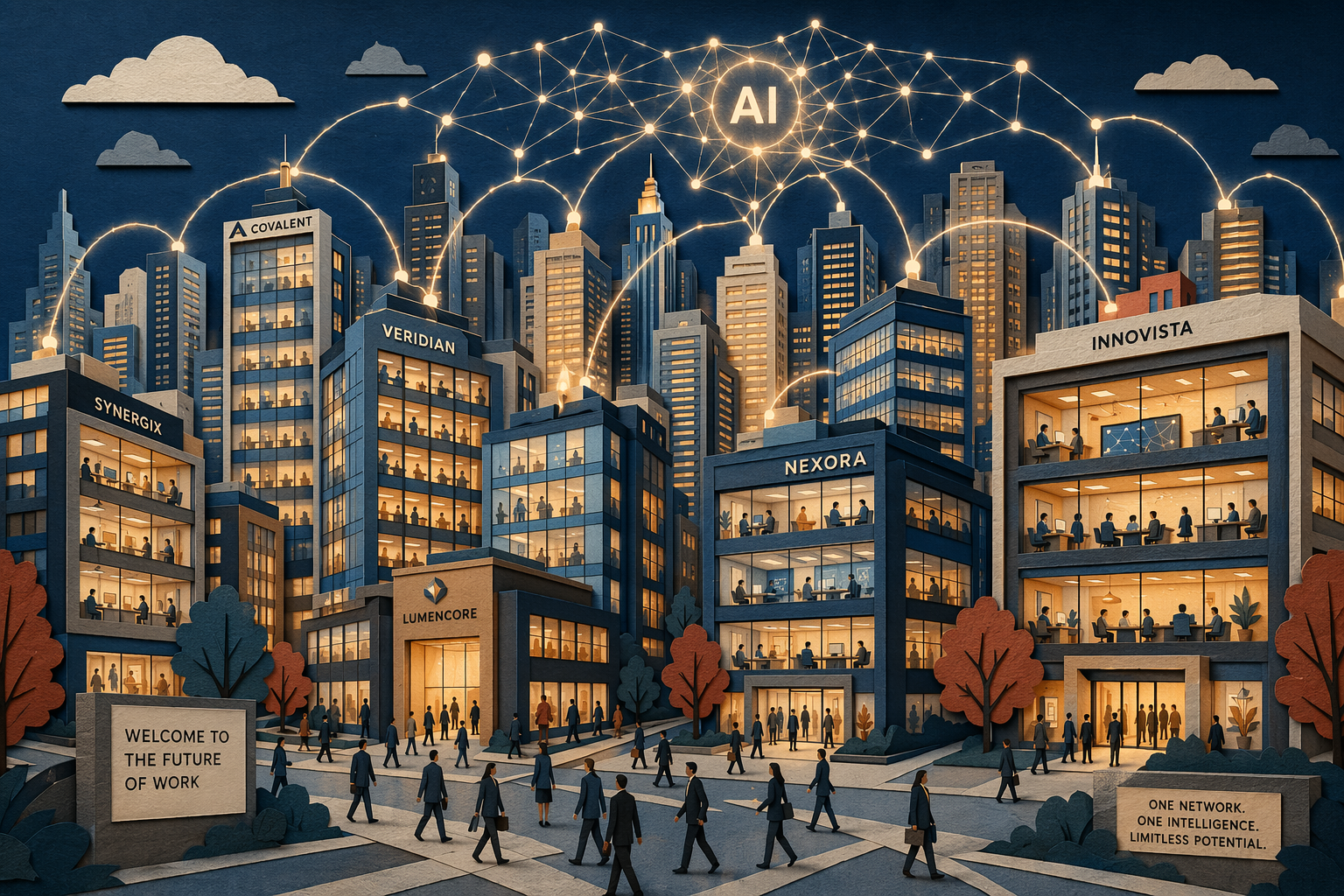
Last week, the Big Four accounting firms apparently listened to the advice I spent three years giving enterprises as an AI transformation consultant: stop piloting. Commit. All four committed in the same month. And the ripple effects, from PhD-level math to compute economics to agent governance, tell a bigger story about where this industry actually is right now.

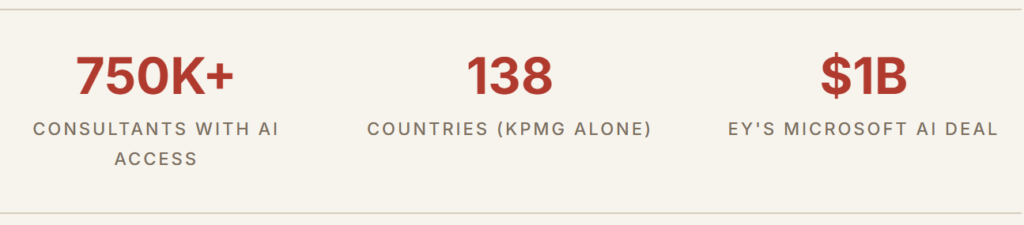
KPMG signed a global alliance with Anthropic on May 19, deploying Claude to all 276,000 employees across 138 countries by September 2026. A new product called KPMG Blaze embeds Claude Code into IT modernization work. Five days earlier, PwC signed a 30,000-seat Claude deal. EY inked a $1 billion Microsoft AI agreement on May 21. Deloitte already rolled Claude out to roughly 470,000 employees before any of them moved.
I remember sitting in boardrooms where “AI strategy” meant a 30-slide deck and a 6-month timeline for a proof of concept. That era ended quietly. The procurement motion now resembles enterprise SaaS deals from 2015: multi-year contracts, multi-country rollouts, infrastructure lock-in.
For founders: the competitive benchmark just shifted. If you sell into professional services, your product now competes with Claude embedded in the daily workflow. KPMG CEO Bill Thomas framed it as “redefining how work gets done.” That is not pilot language. That is restructuring language.
Operator Signal
The part most companies miss in a rollout this big is the real-time signal. What are employees actually saying on LinkedIn and Reddit about the tools they are being asked to use? What are clients posting on X about their audit firm going full AI? Adoption dashboards measure logins. Social platforms capture honest reactions. That is exactly the gap SocialCrawl’s API fills: one query across Reddit, LinkedIn, X, Threads, and YouTube surfaces real sentiment around an enterprise rollout, sourced from the people living through it.

Fields Medalist Timothy Gowers published a blog post on May 8 stating that ChatGPT 5.5 Pro independently produced doctoral-level combinatorics research with zero contribution from him. The entire process took under two hours. MIT student Isaac Rajagopal called the model’s technique “the sort of idea I would be very proud to come up with after a week or two of pondering.”
Then on May 20, OpenAI separately announced that a reasoning model had autonomously disproved the Erdos unit distance conjecture, an open geometry problem standing for 80 years. Nine independent mathematicians verified the proof, Gowers among them.
“We are all having to keep revising upwards our assessments of the mathematical capabilities of large language models.”
Timothy Gowers, Fields Medalist
Two PhD-level breakthroughs in one month. One verified by a Fields Medalist. The other by nine independent reviewers. Gowers predicted that mathematical research could be “transformed out of all recognition” by 2029.
For founders in scientific computing, drug discovery, or financial modeling, the competitive window before AI commoditizes expert reasoning is shrinking fast. The “human-in-the-loop for quality” assumption in research workflows needs re-examination now, not later.
The researcher community is polarized. On Hacker News and X, the reaction splits between awe and existential dread. If you are building where expert reasoning is the moat, tracking that discourse in real time matters. The community’s shifting sentiment affects hiring decisions, investor confidence, and customer willingness to trust automated analysis. SocialCrawl makes that sentiment searchable across platforms before it shows up in headlines.

On May 18, Blackstone committed $5 billion in equity to a joint venture with Google, building a TPU-as-a-service offering outside of Google Cloud’s standard platform. Total project scale could reach $25 billion with debt financing. The first 500 MW of compute capacity targets 2027, led by former Google VP Benjamin Treynor Sloss as CEO.
This matters because Google has never offered TPU access through a vehicle independent of its standard cloud. If this model works, it could crack the hyperscaler lock-in that currently forces startups to choose between AWS, Google Cloud, or Azure.
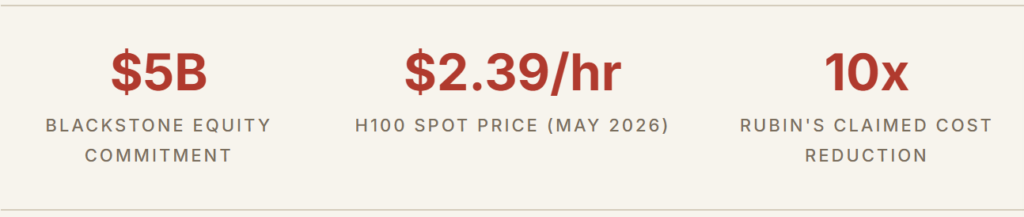
The timing is sharp. NVIDIA H100 spot prices hit $2.39 per hour in May, highest in months. Inference now represents 55% of all AI infrastructure spending. Meanwhile, NVIDIA’s Rubin platform entered full production in Q1 2026 ahead of schedule, claiming a 10x token cost reduction over Blackwell. Rubin-based instances are deploying at AWS, Google Cloud, Azure, CoreWeave, and Lambda in H2 2026.
For founders building inference-heavy products (agents, real-time processing, long-context reasoning), two forces are converging: cheaper TPU access outside Google Cloud and a potential 10x cost drop from NVIDIA’s next platform. Your unit economics could look very different by early 2027.

On May 1, CISA, NSA, and cybersecurity agencies from Australia, Canada, New Zealand, and the UK jointly published “Careful Adoption of Agentic AI Services.” It is the first coordinated multi-government security guidance specifically addressing autonomous agent deployments.
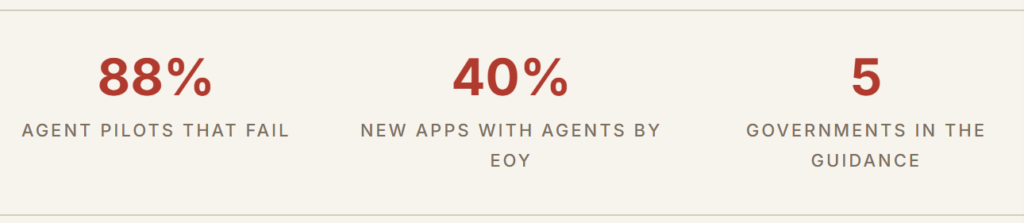
The headline number: 88% of autonomous agent pilots fail before reaching production. Not because the models are bad. Because governance and observability gaps kill them.
The document calls out specific failure modes: agents calling tools with wrong parameters, executing tasks in the wrong order, sending emails or deleting records without human approval. Recommended controls include least-privilege permissions, full action logging, human approval gates for high-risk tasks, and kill switches.
Separately, analysts estimate that 40% of new enterprise applications will include agentic capabilities by end of 2026, up from under 5% in 2025. That is a collision course. Agent adoption is accelerating faster than governance tooling can keep up.
For founders building agent platforms or selling into regulated industries, this document is a pre-regulatory checklist. The monetizable problem is not more capable models. It is observability, audit trails, and trust infrastructure.
Operator Signal
This is where real-time social intelligence becomes a strategic input. If you are deploying agents that interact with customers, manage social accounts, or automate public-facing communications, you need to know what people are saying about your brand in real time. SocialCrawl’s API gives you that layer: track sentiment across platforms, catch negative reactions before they escalate, and feed live social context into your agent’s decision-making. When five governments are telling you to add guardrails, the social web is one of the first places those guardrails should look.
The Honest Take
The Big Four going all-in, PhD math falling to models, compute economics getting reshuffled, and governments drawing lines around agents. These are not four separate stories. They are the same story at different zoom levels: AI is becoming infrastructure, and the companies that survive will be the ones who understand what people actually think about it while it happens.
That signal lives on social platforms. Not in press releases. Not in analyst reports. In the messy, real-time conversations where consultants complain about their new Claude workflow and researchers argue about whether their field just ended.
Finding that signal is why we built SocialCrawl.
A near-trillion-dollar valuation, a tech giant declaring independence, Congress writing real law, and developers learning what AI tools…
The model wars are still on. But this week, the real battleground shifted to deployment. June 1, 2026…
OpenAI and Anthropic stopped competing on benchmarks. This week, they started competing on who can install AI inside…